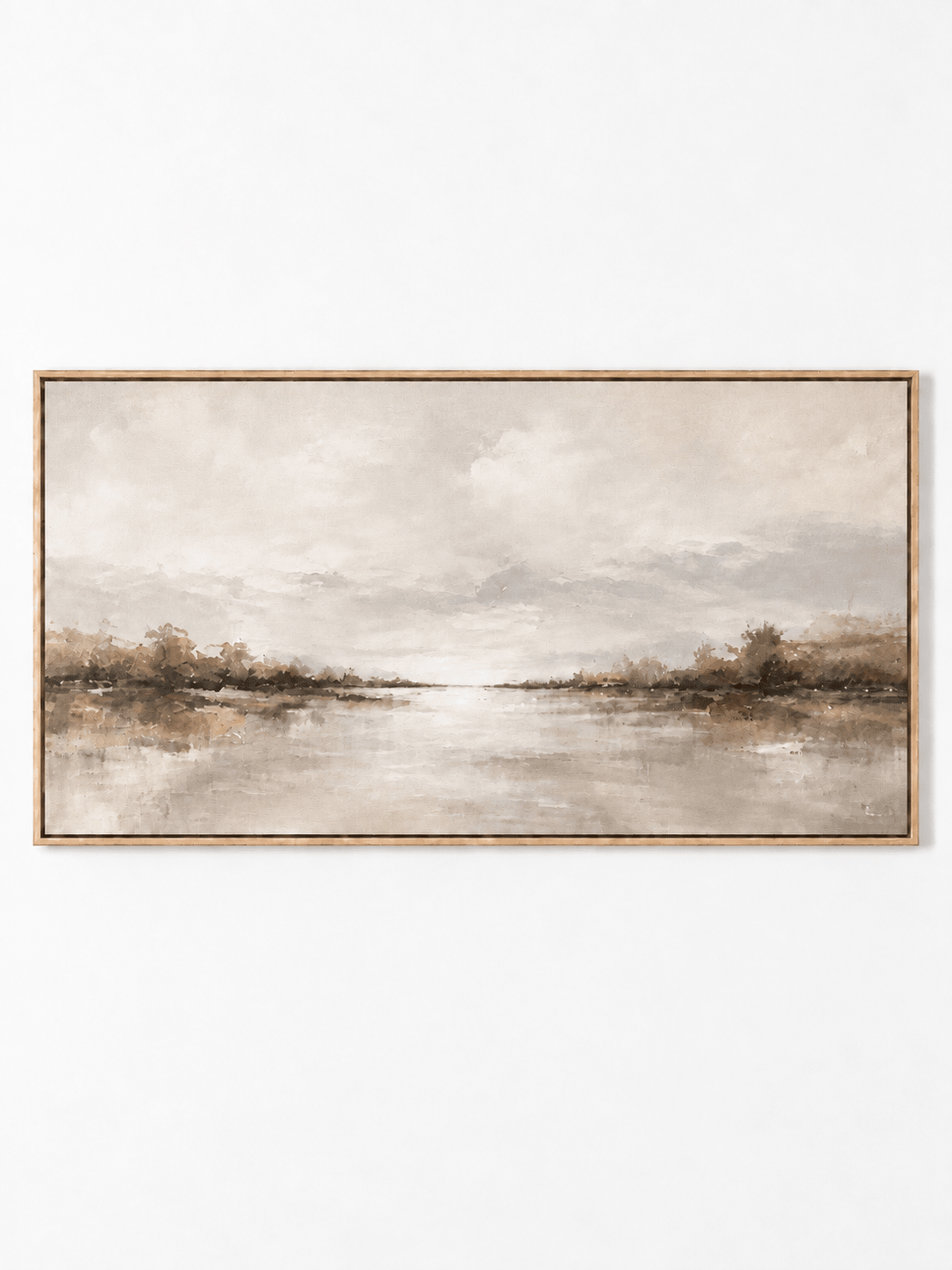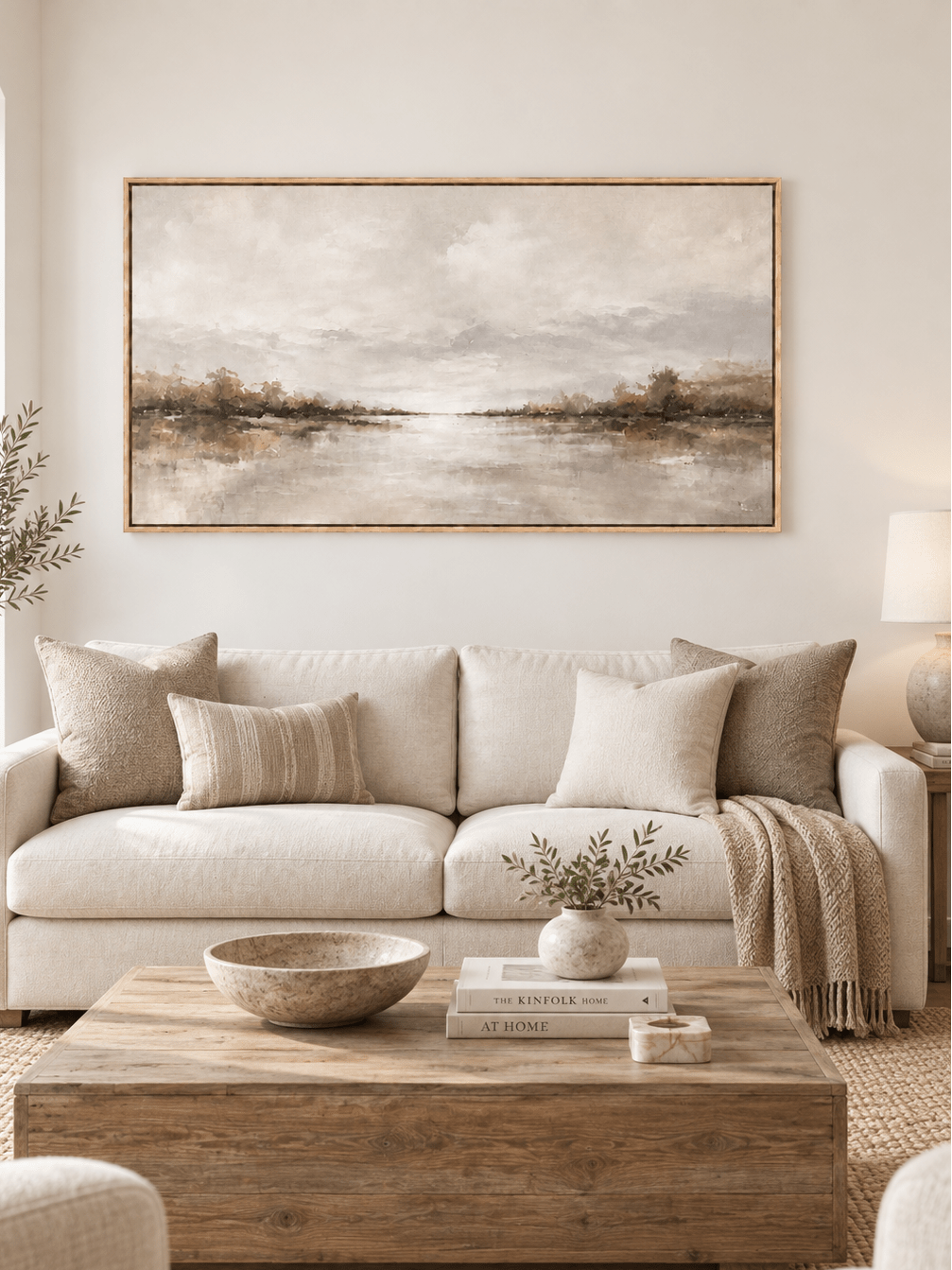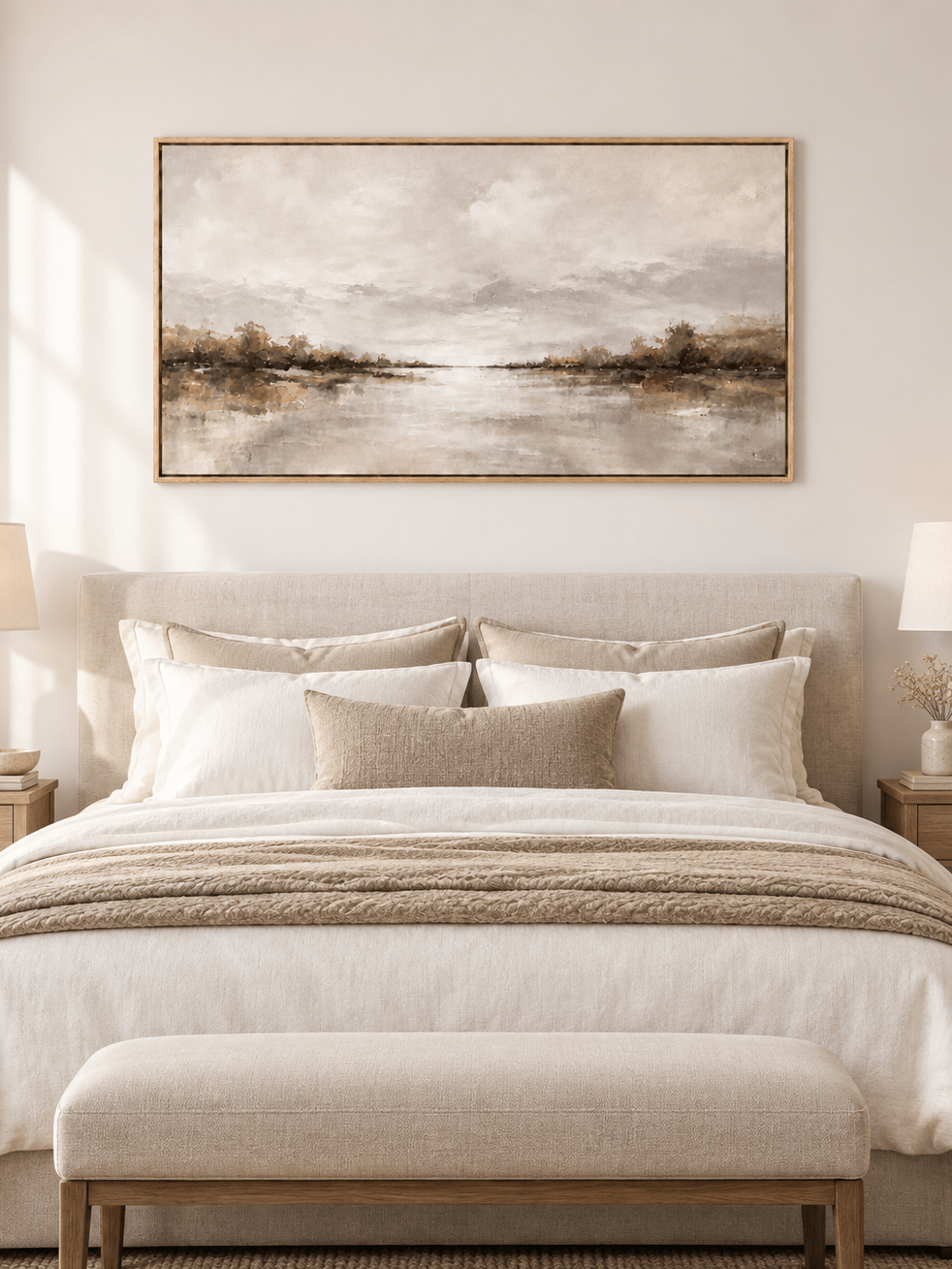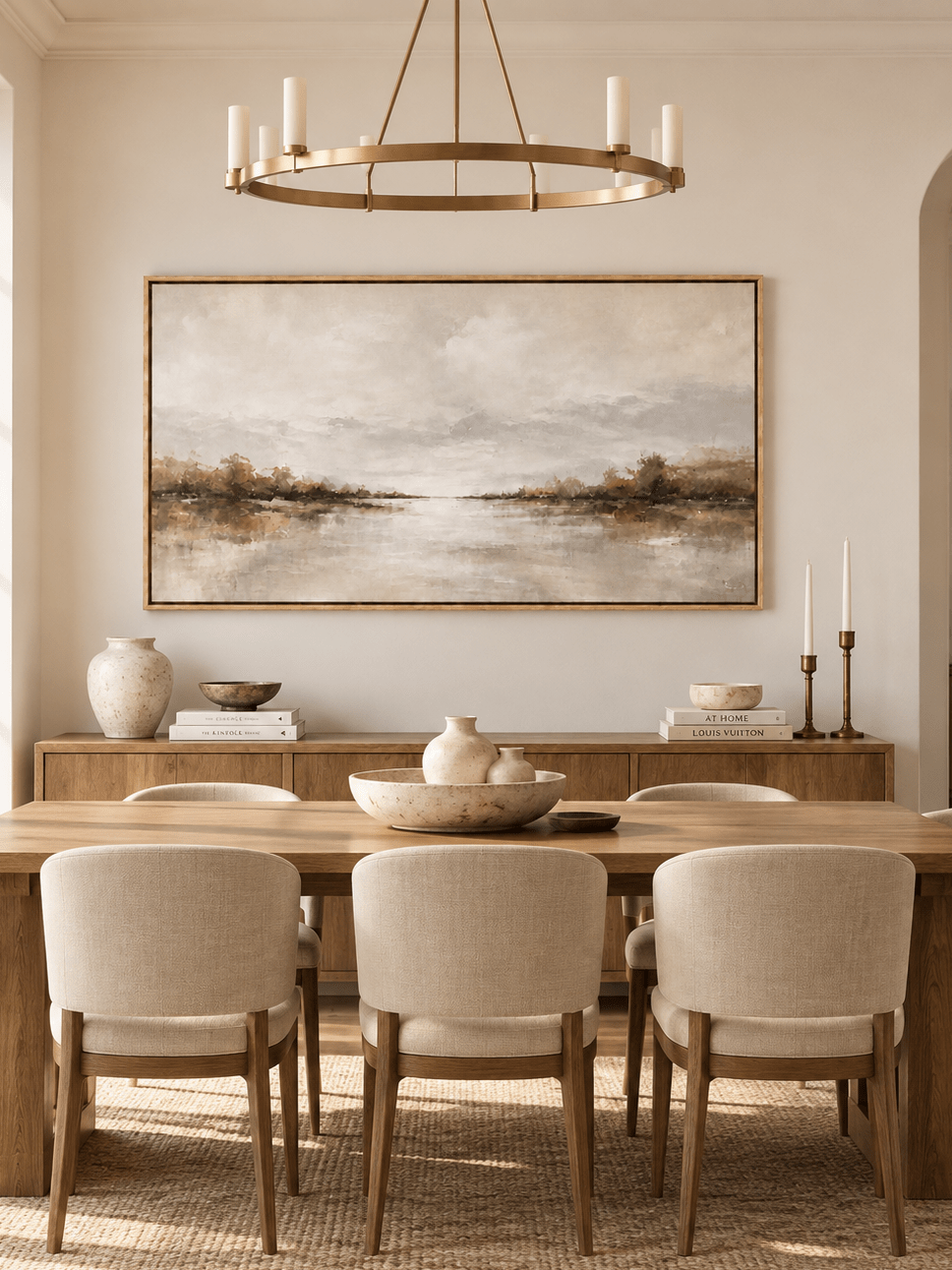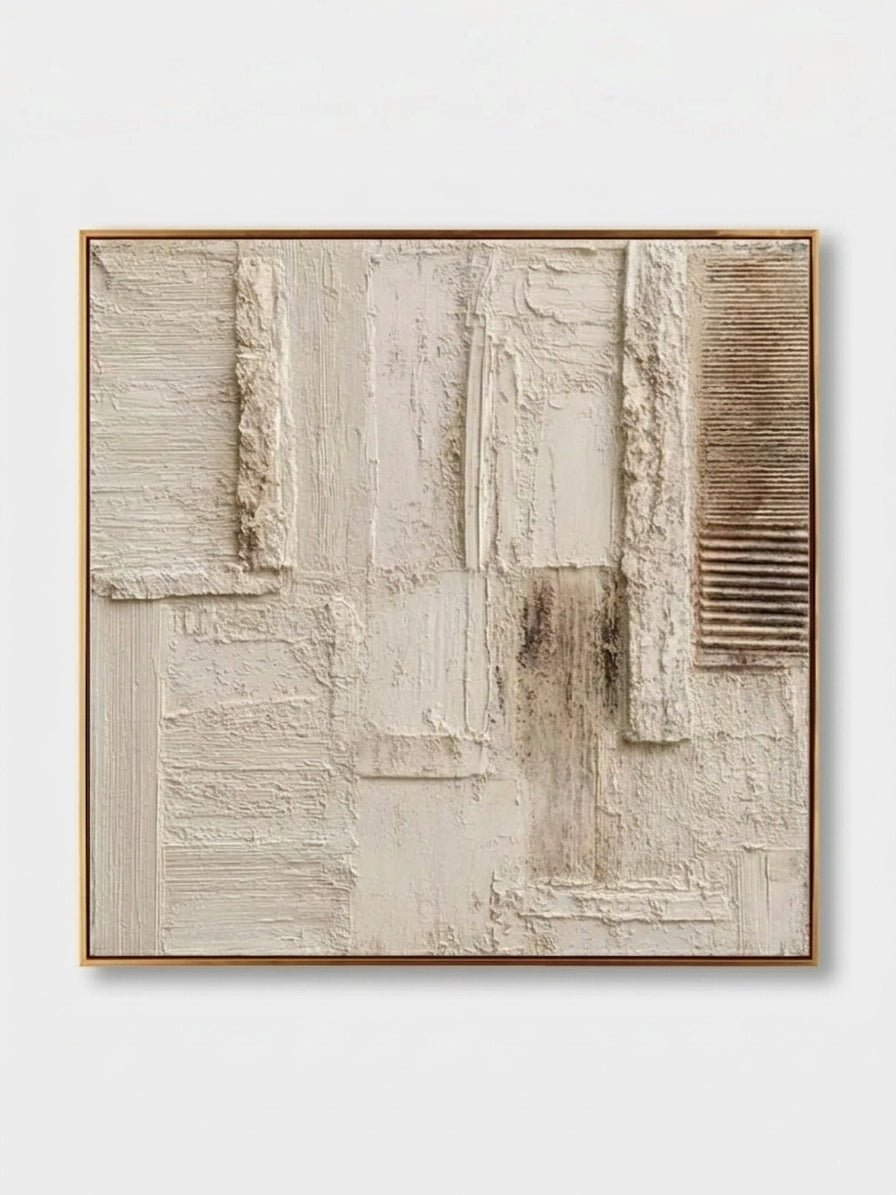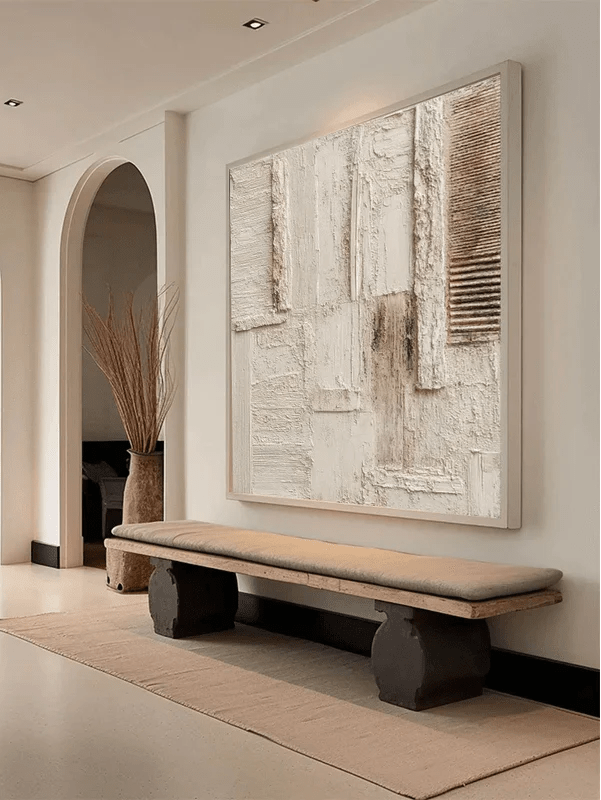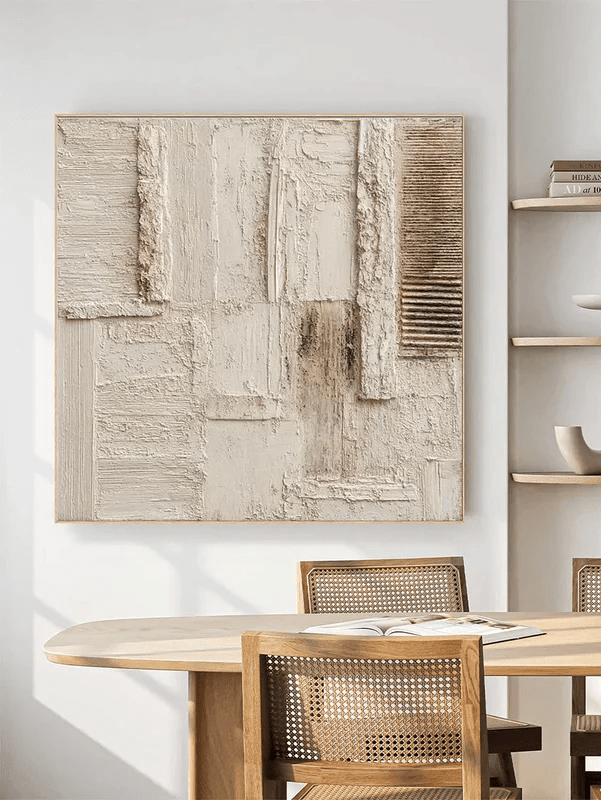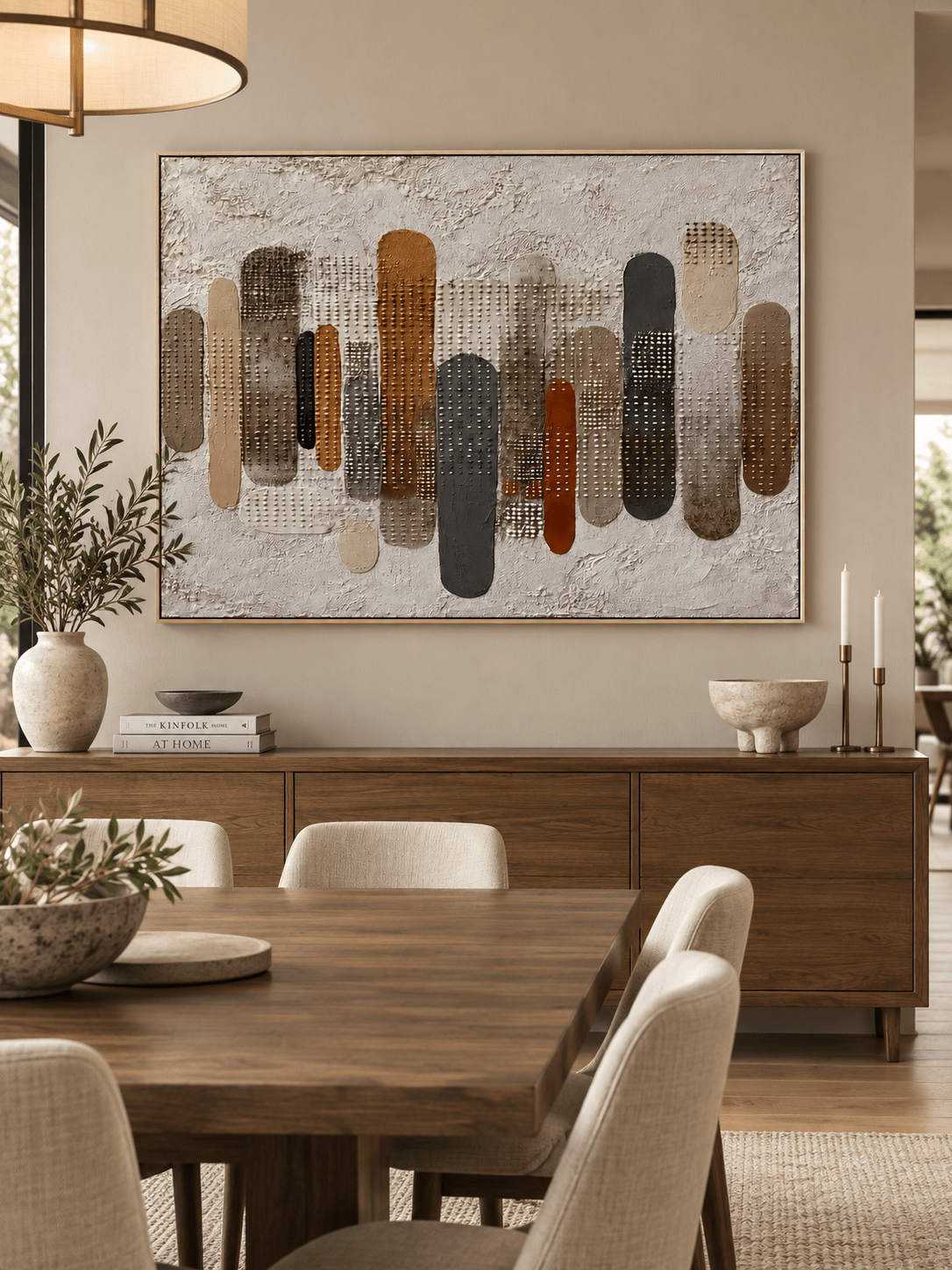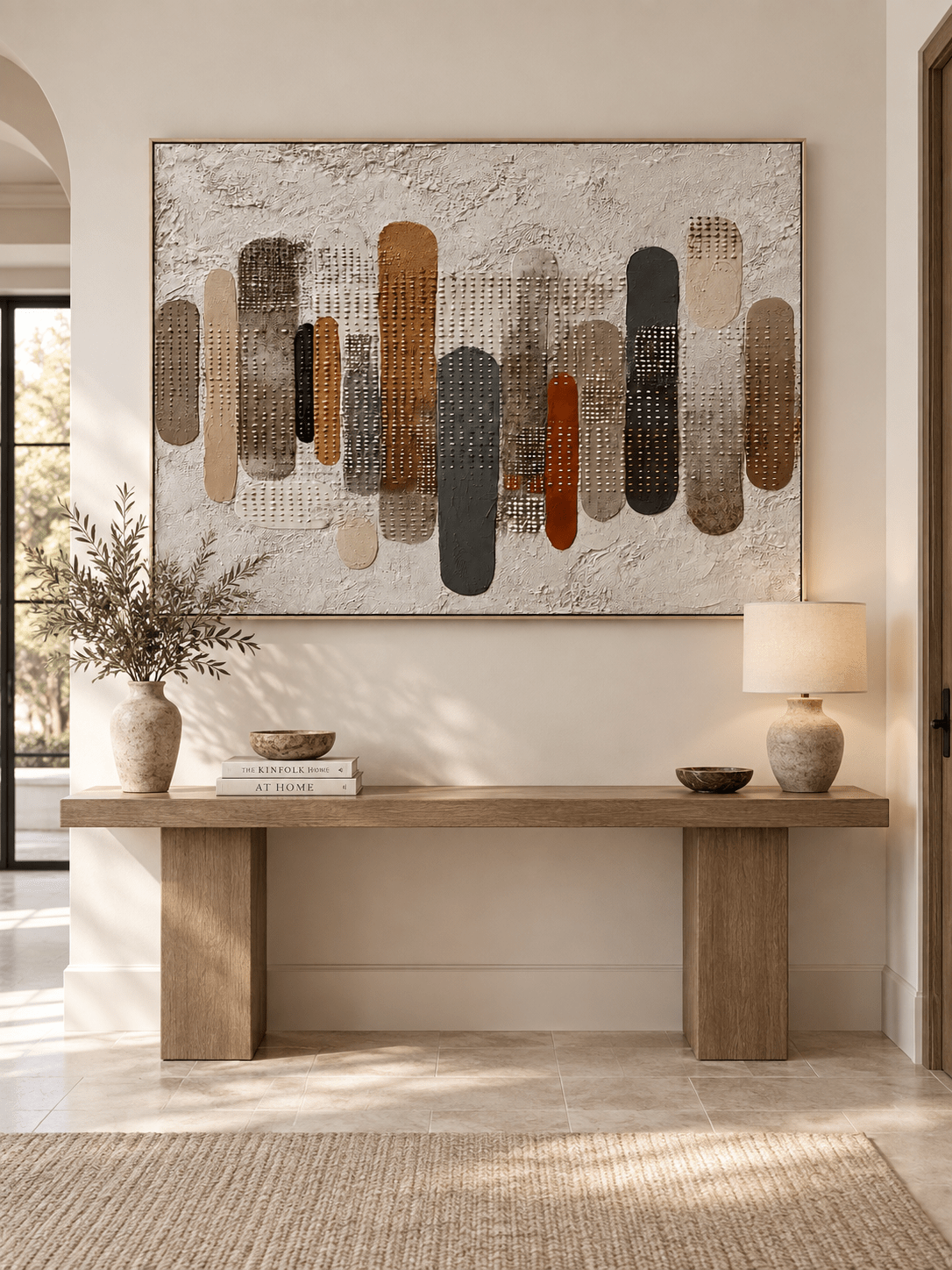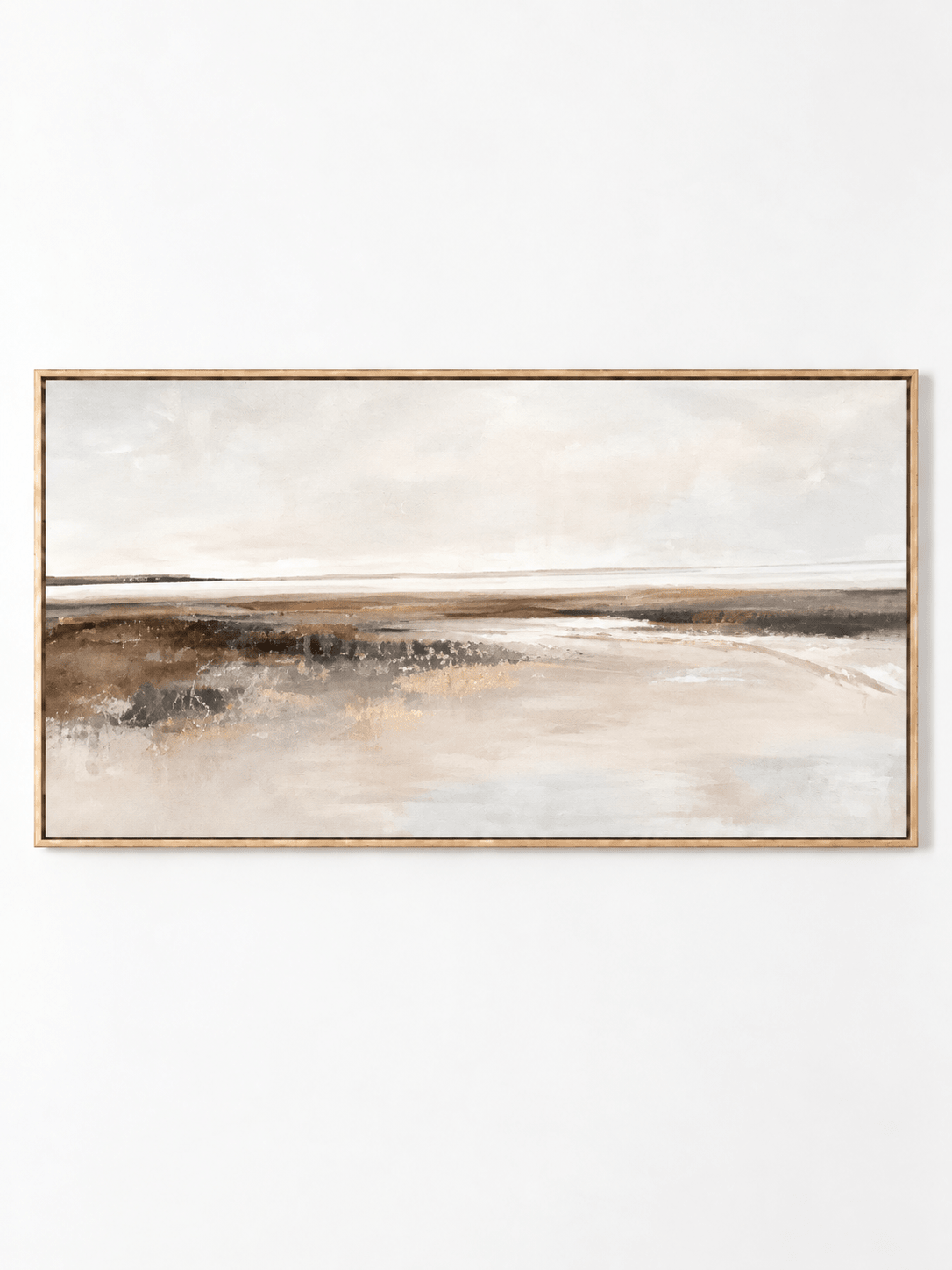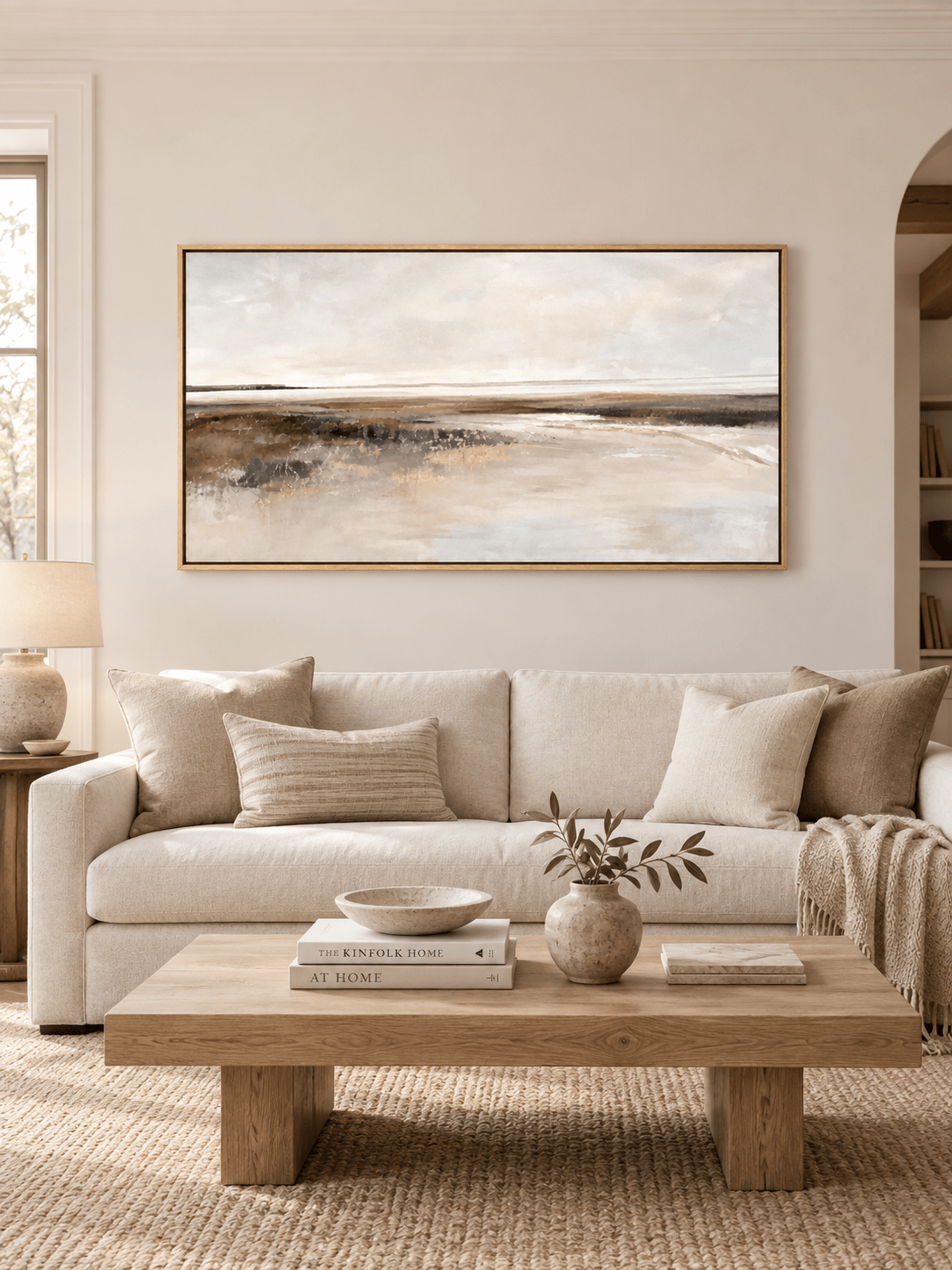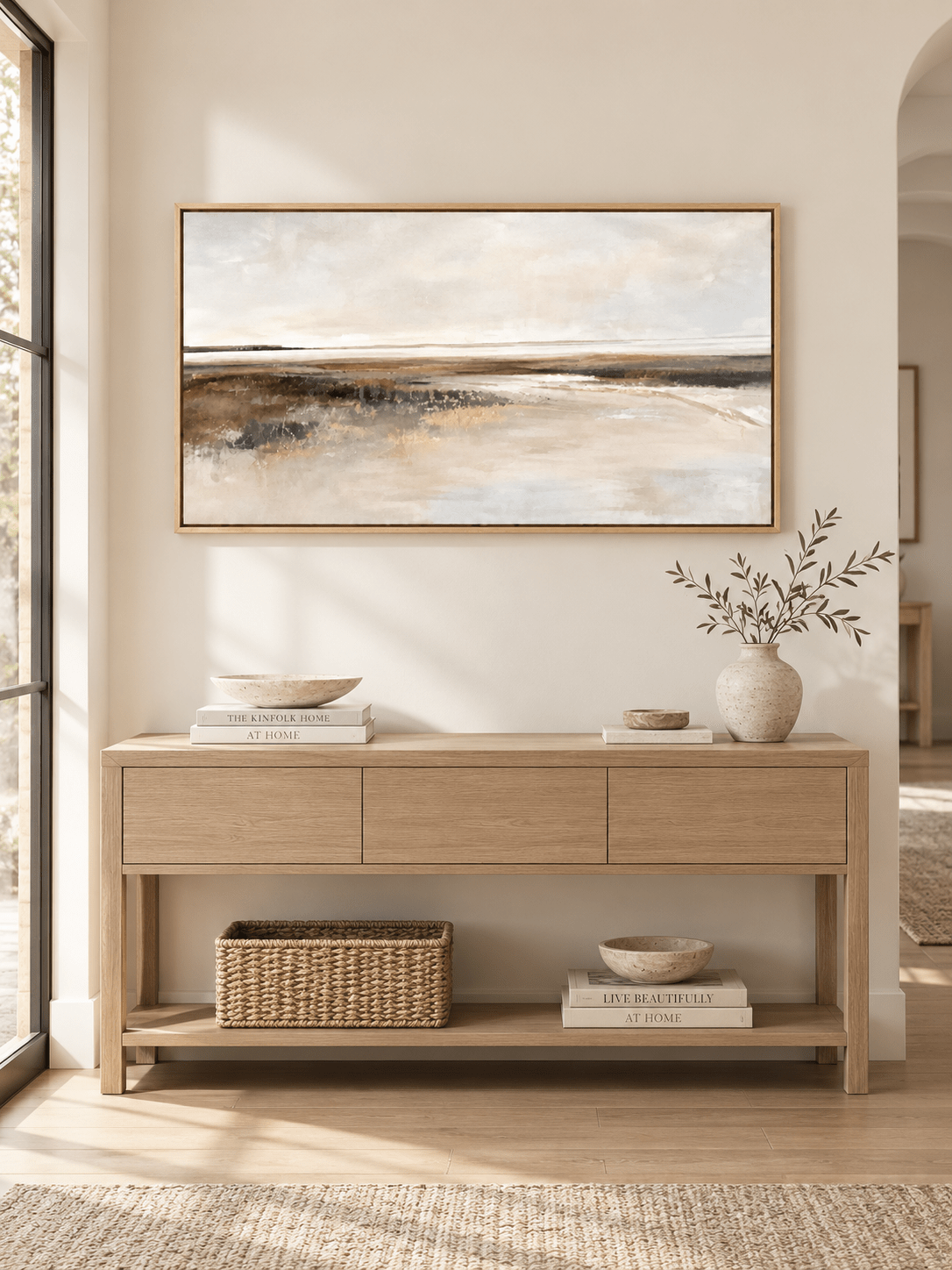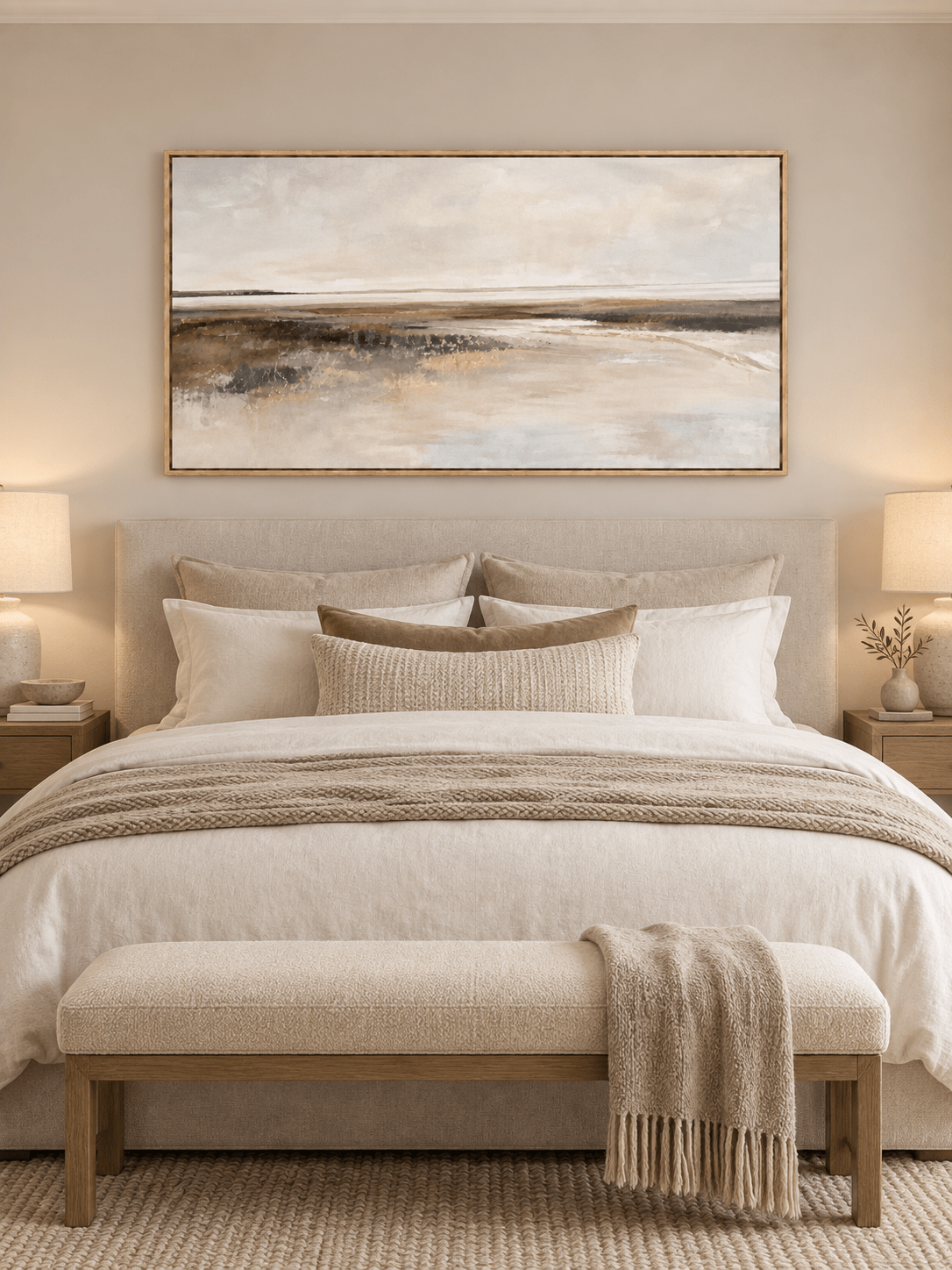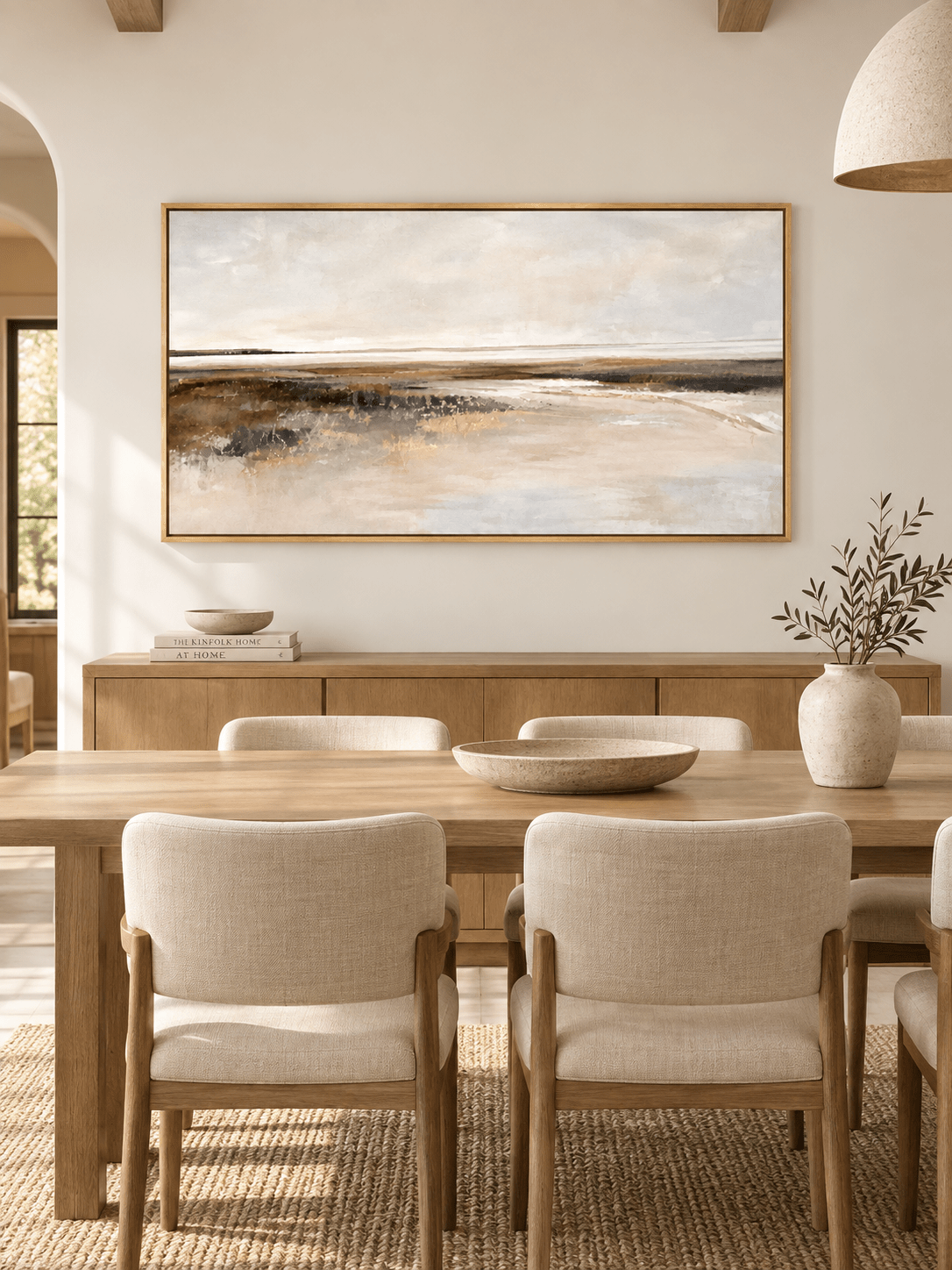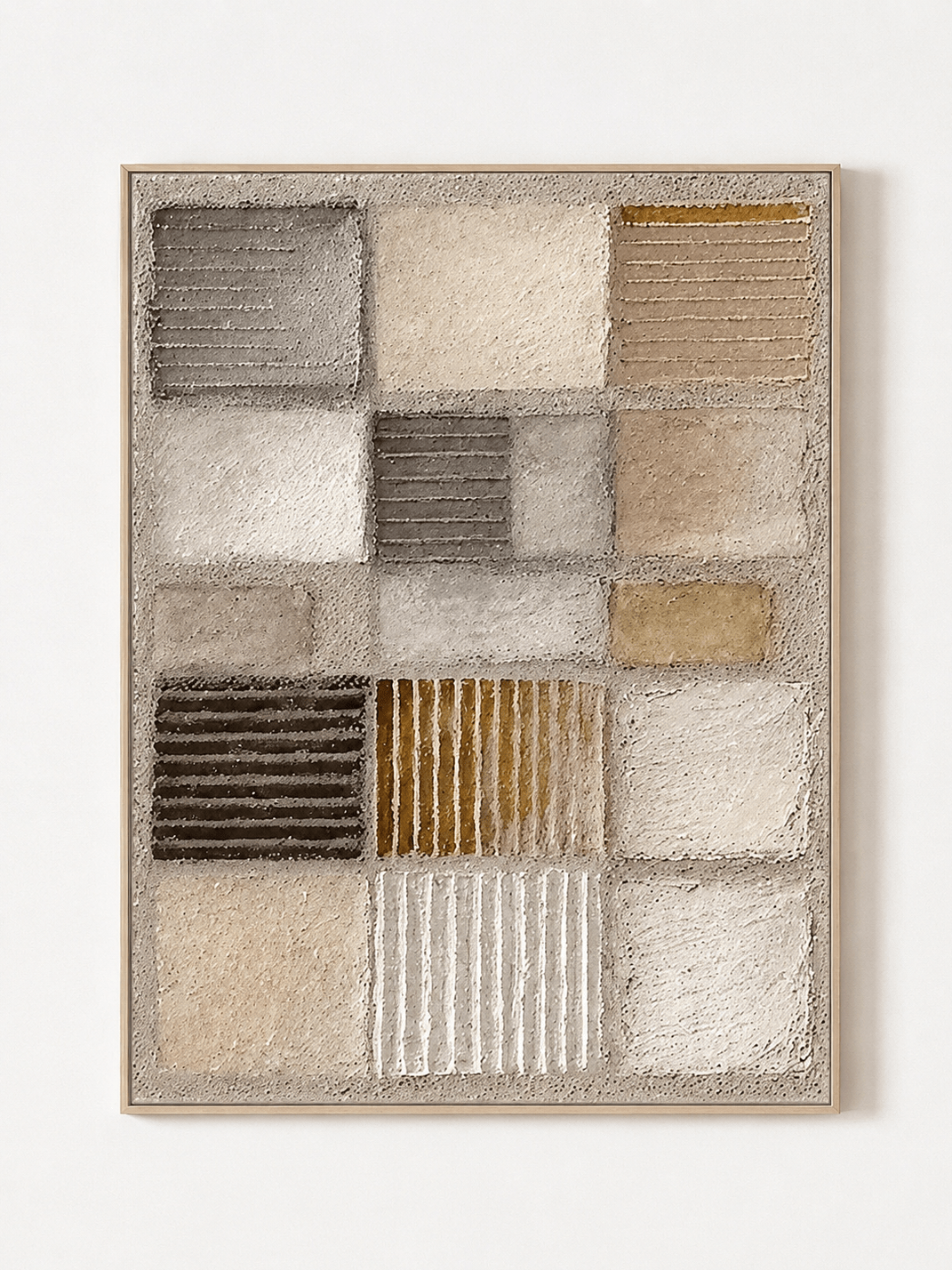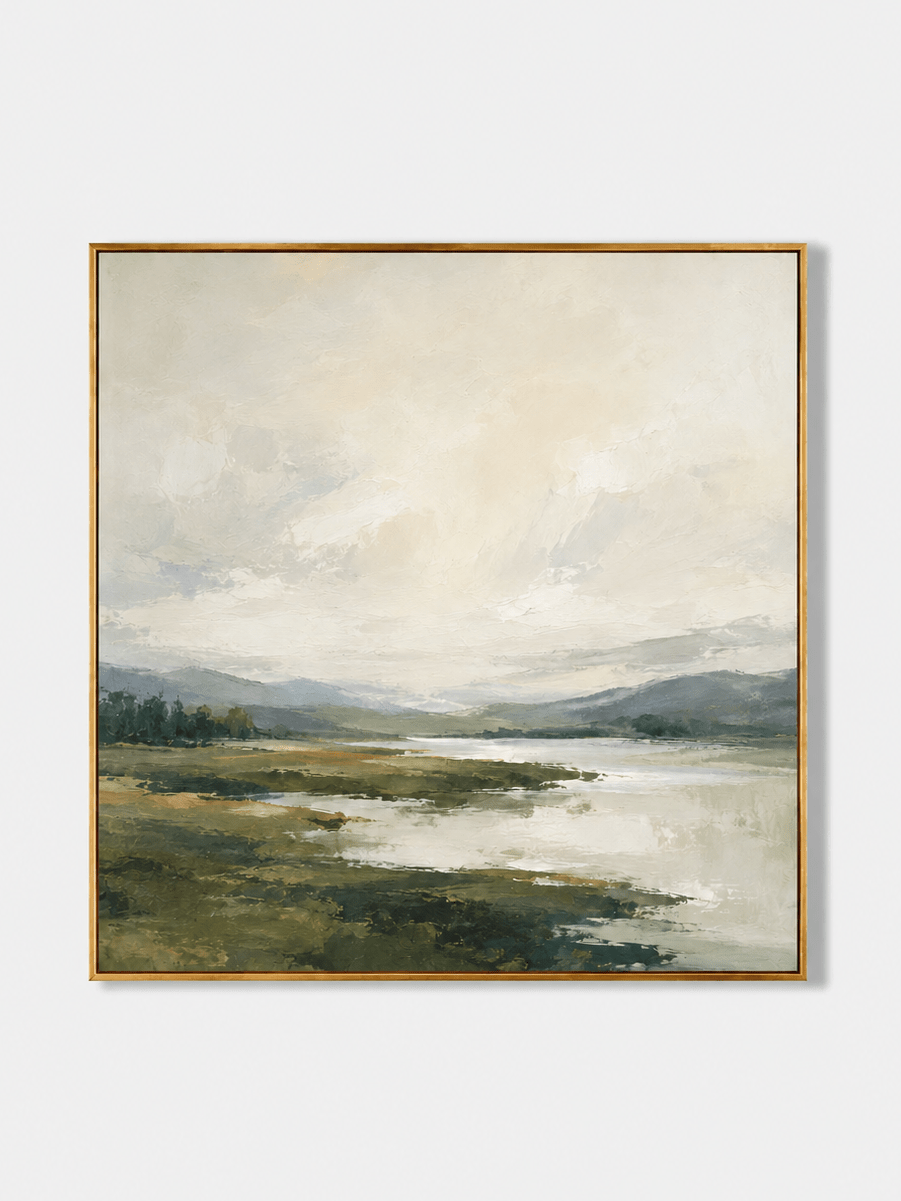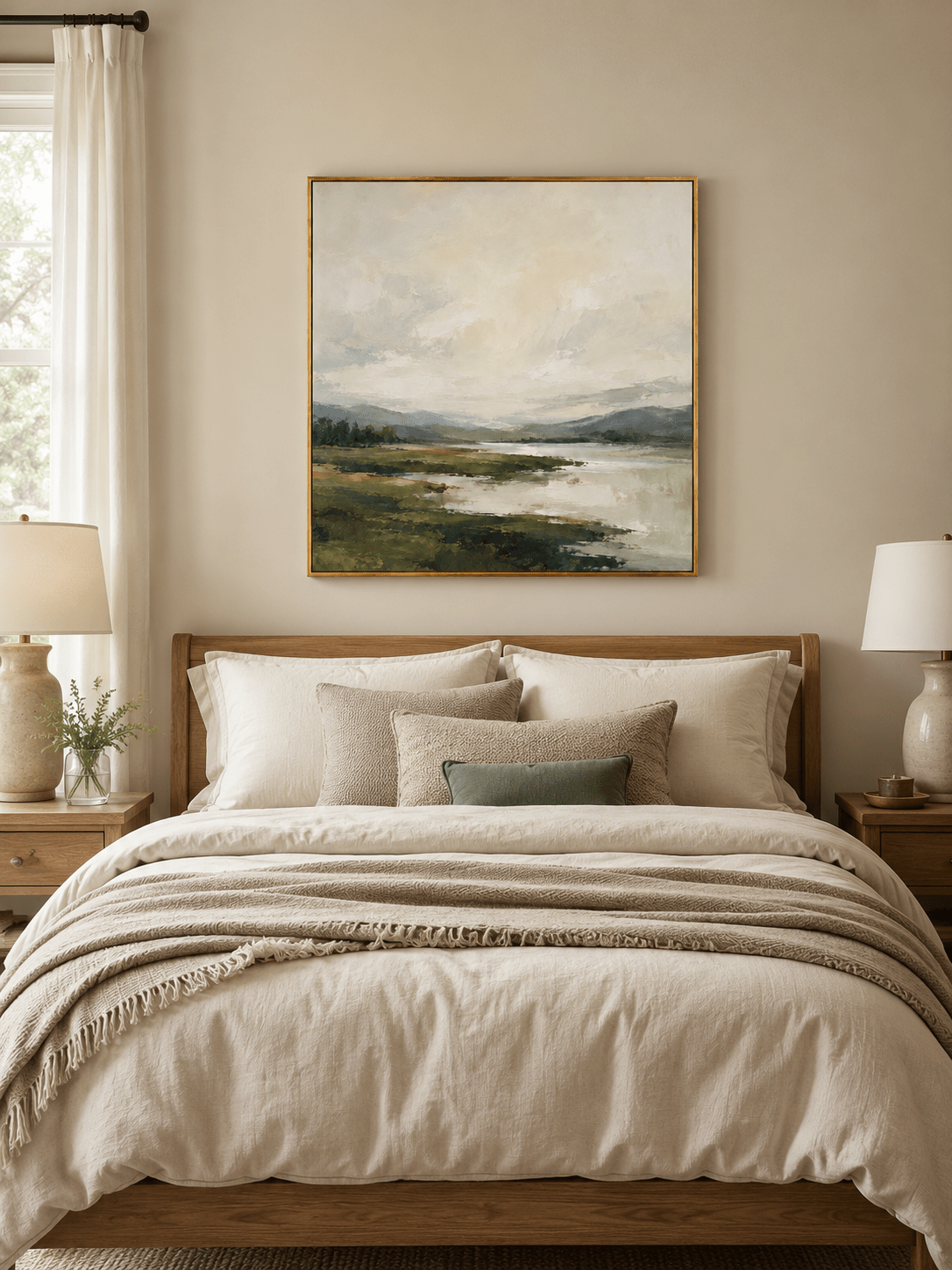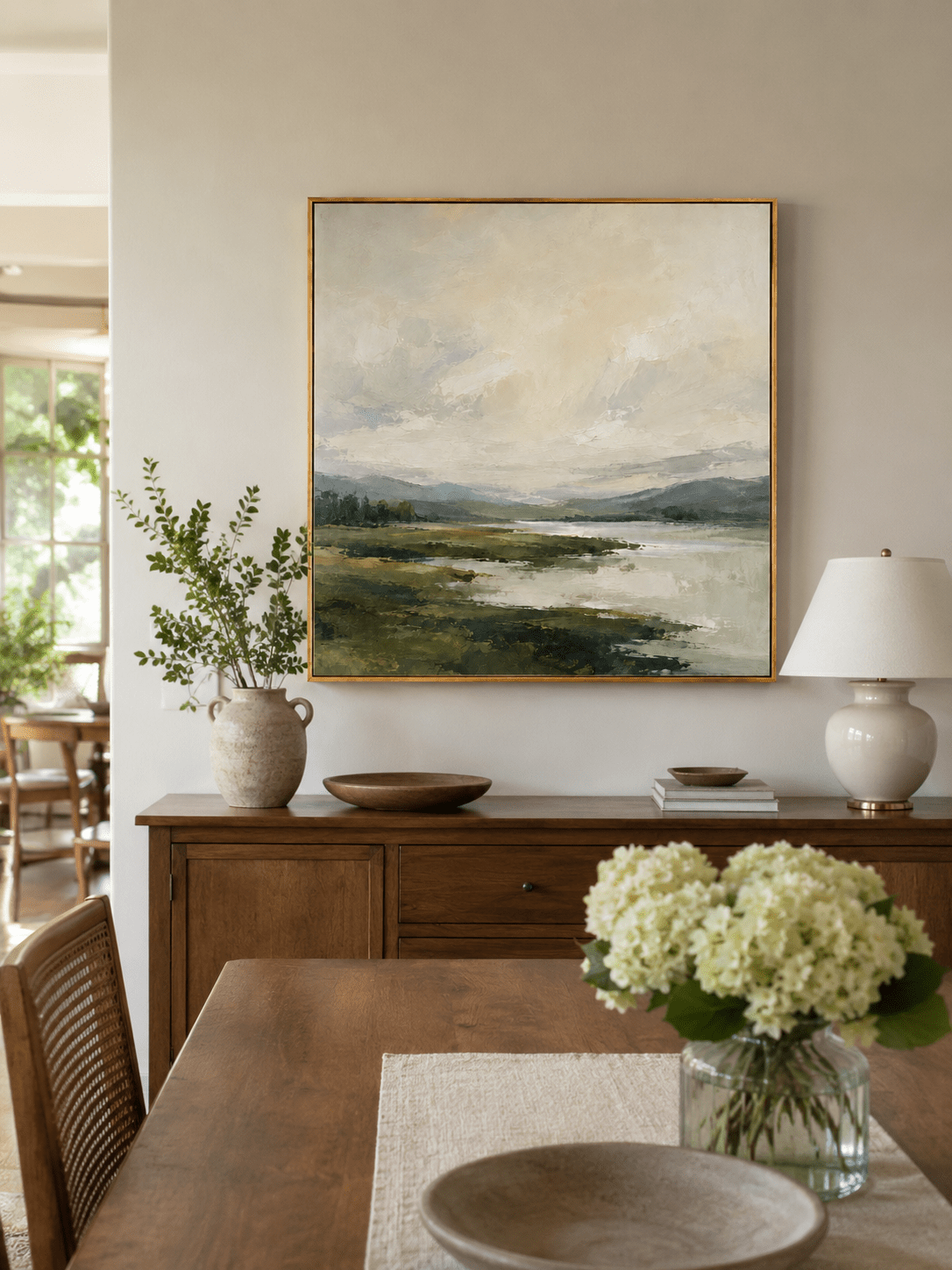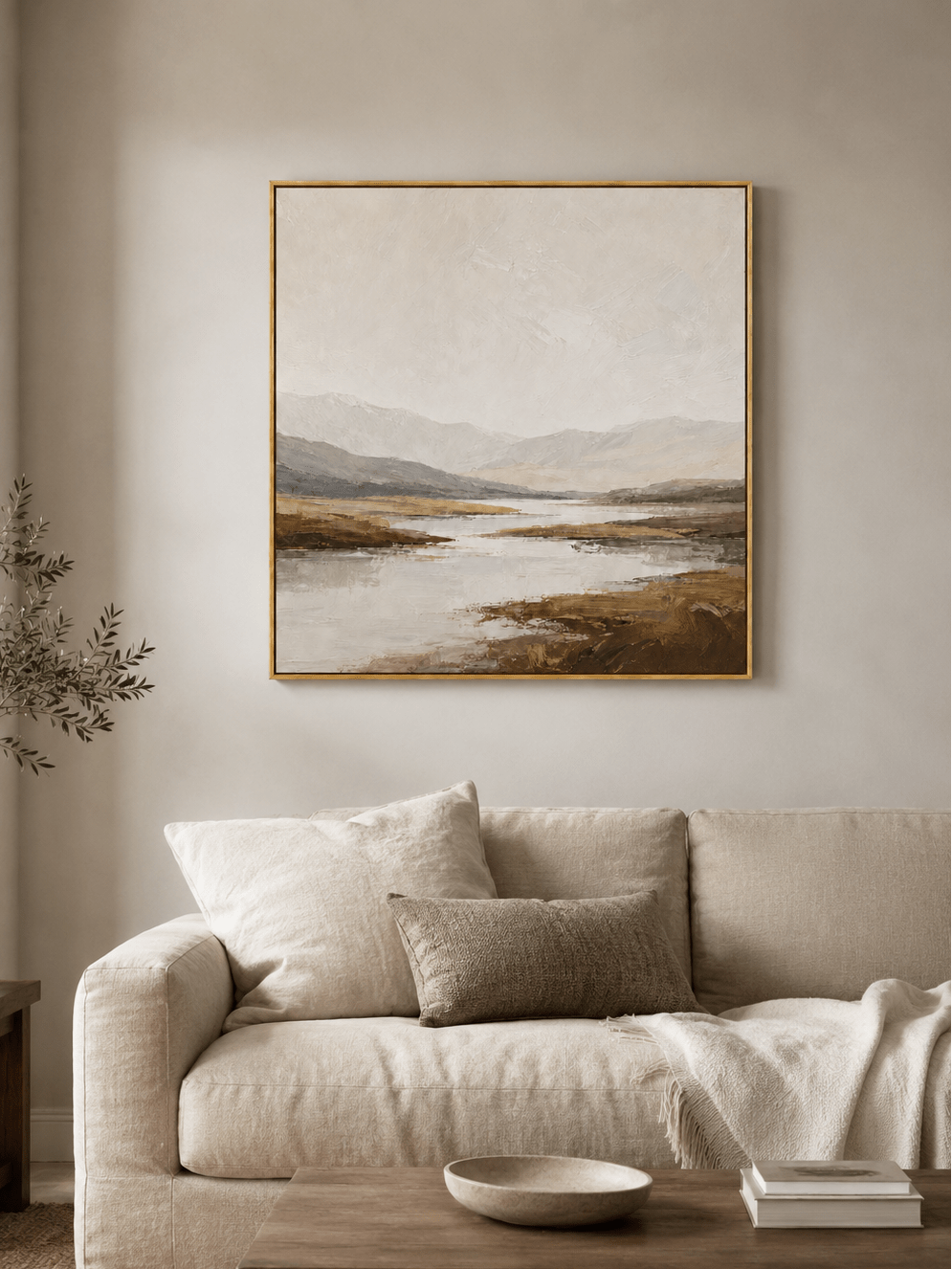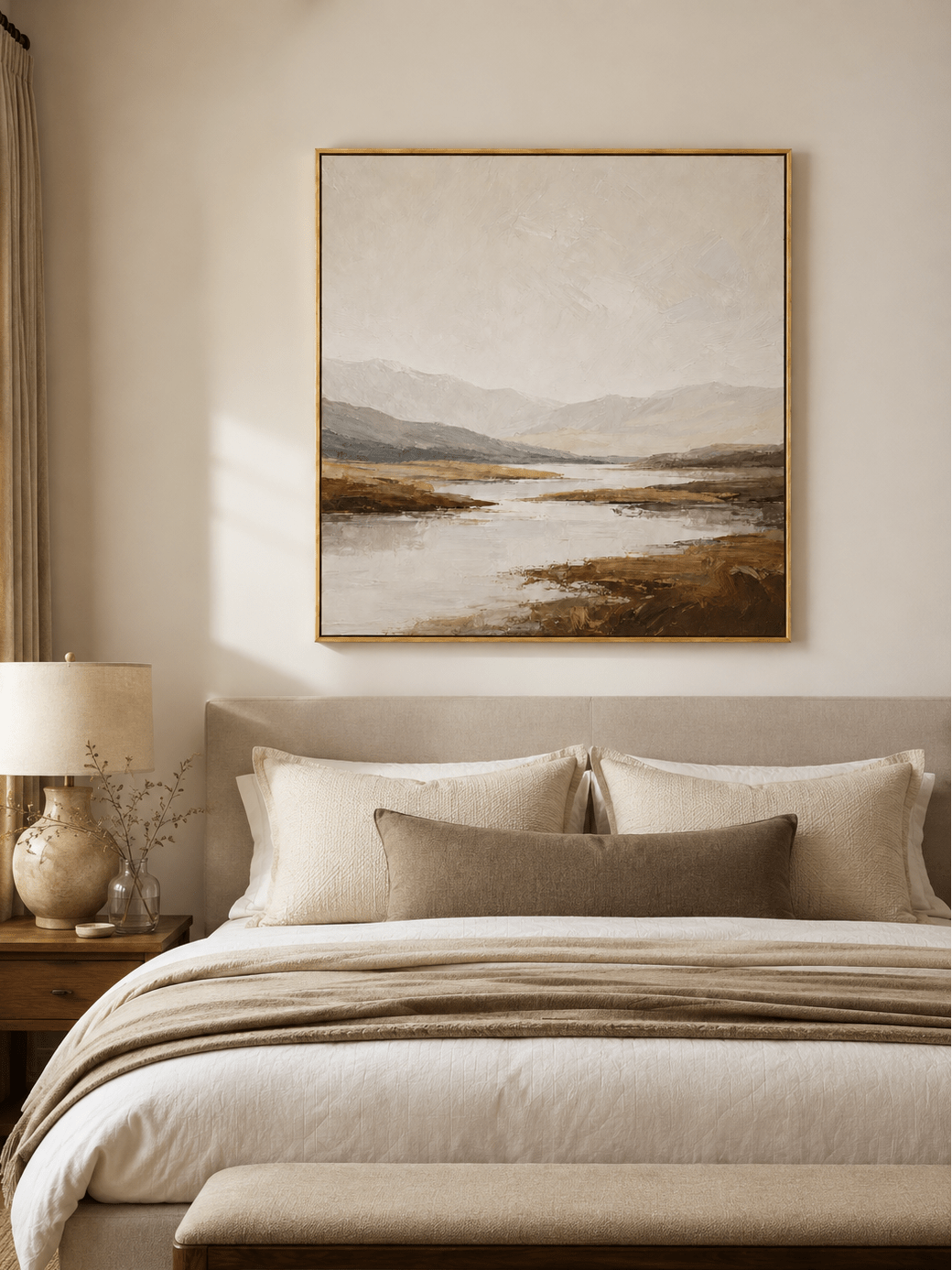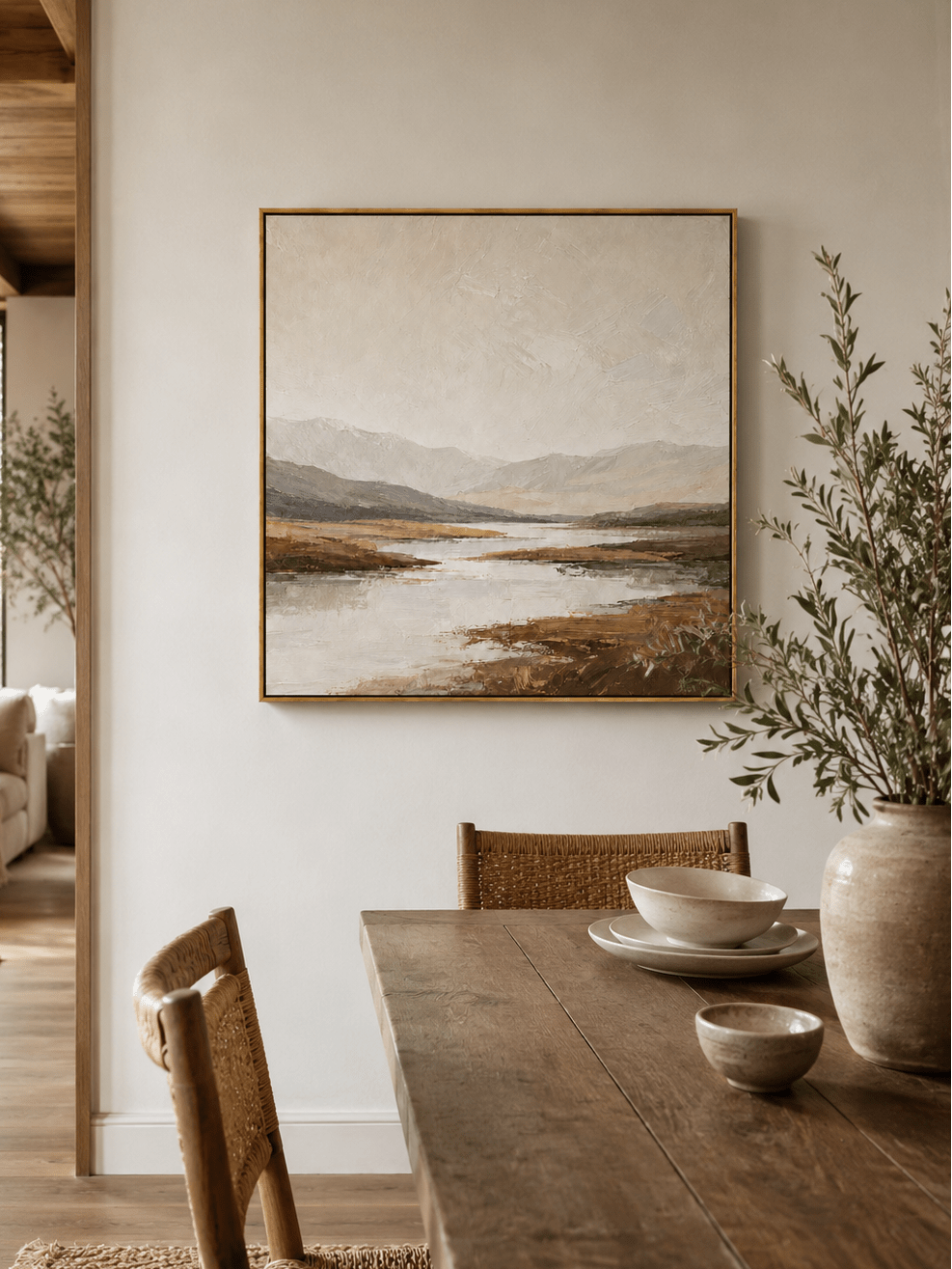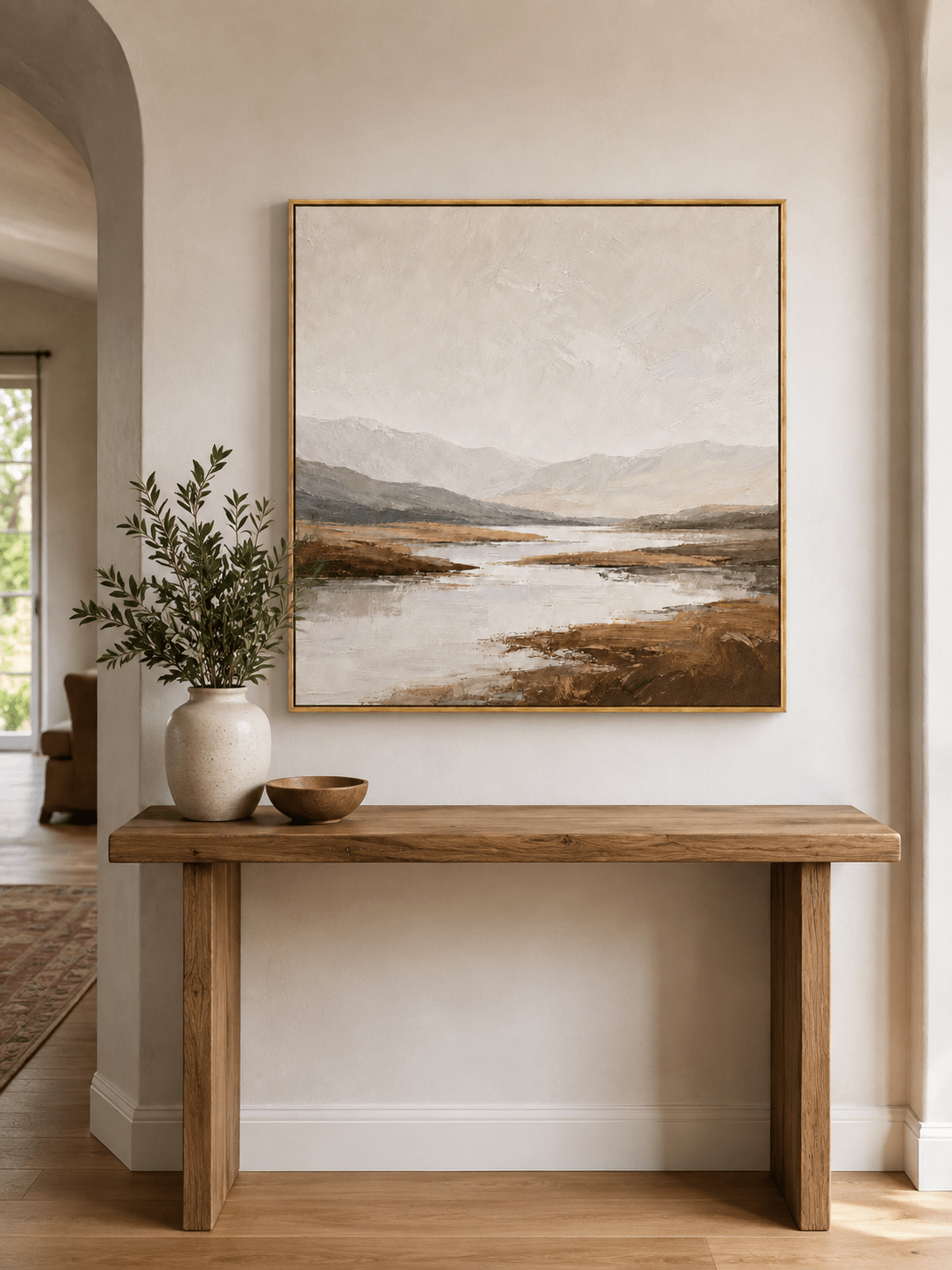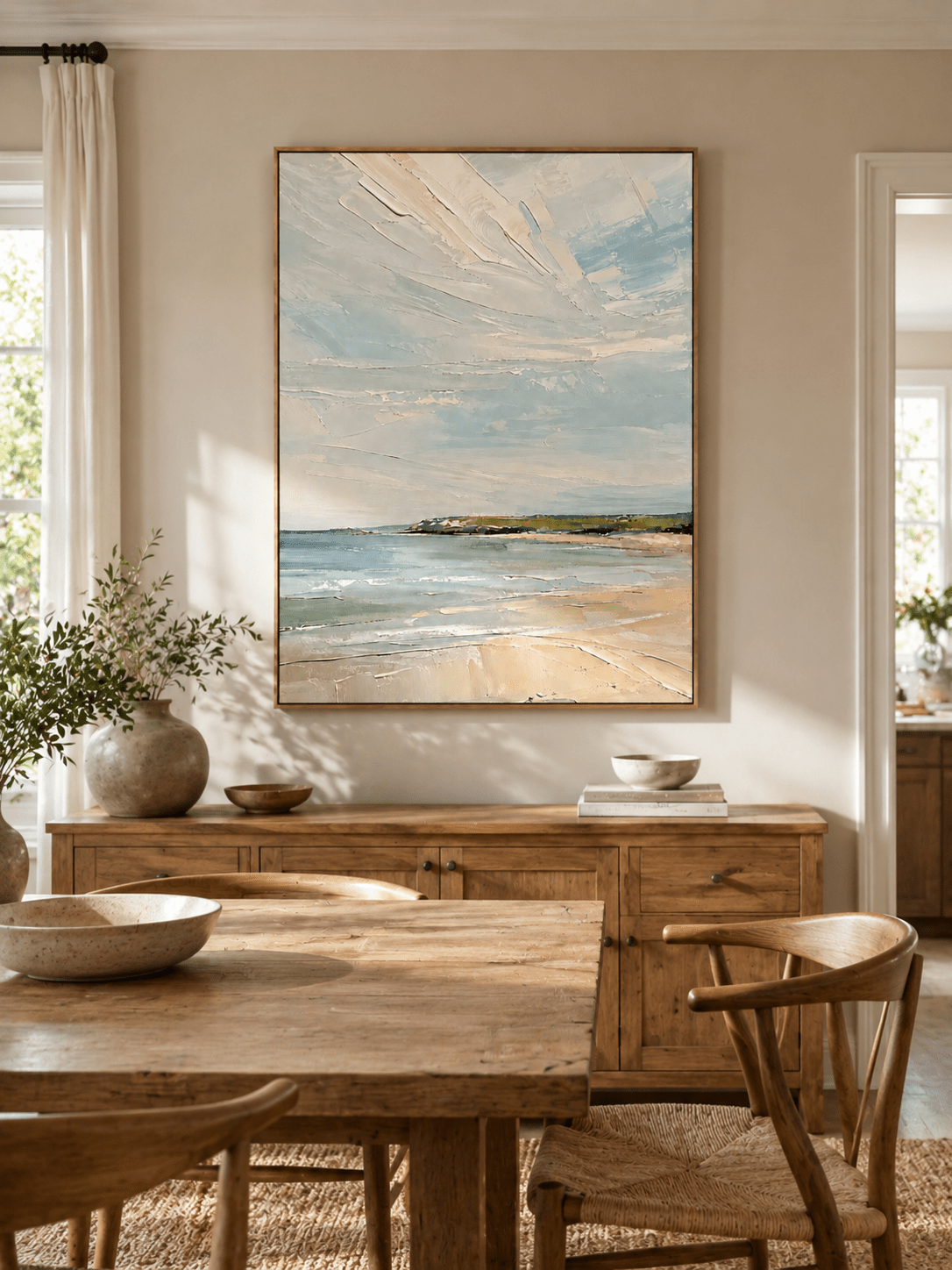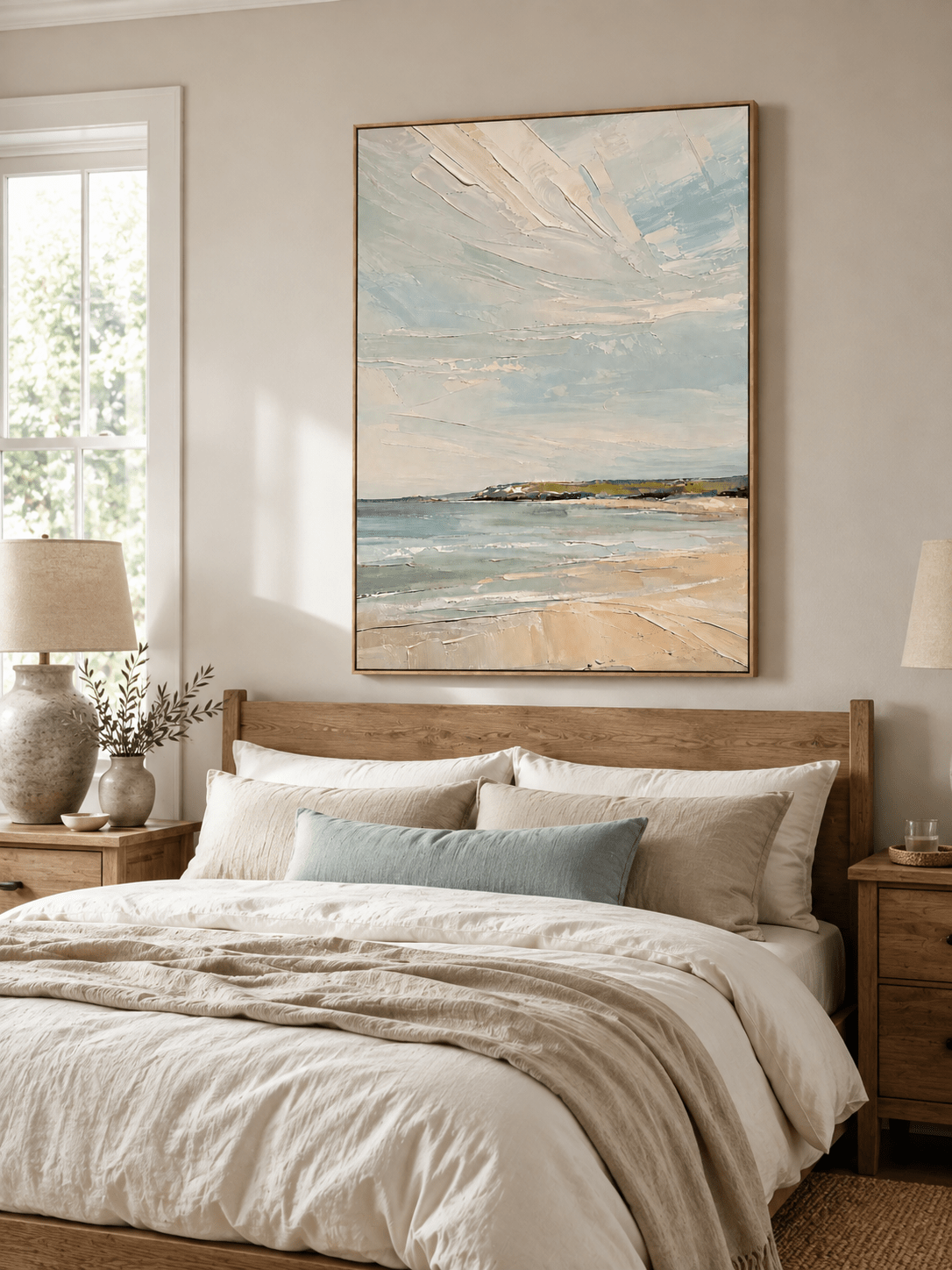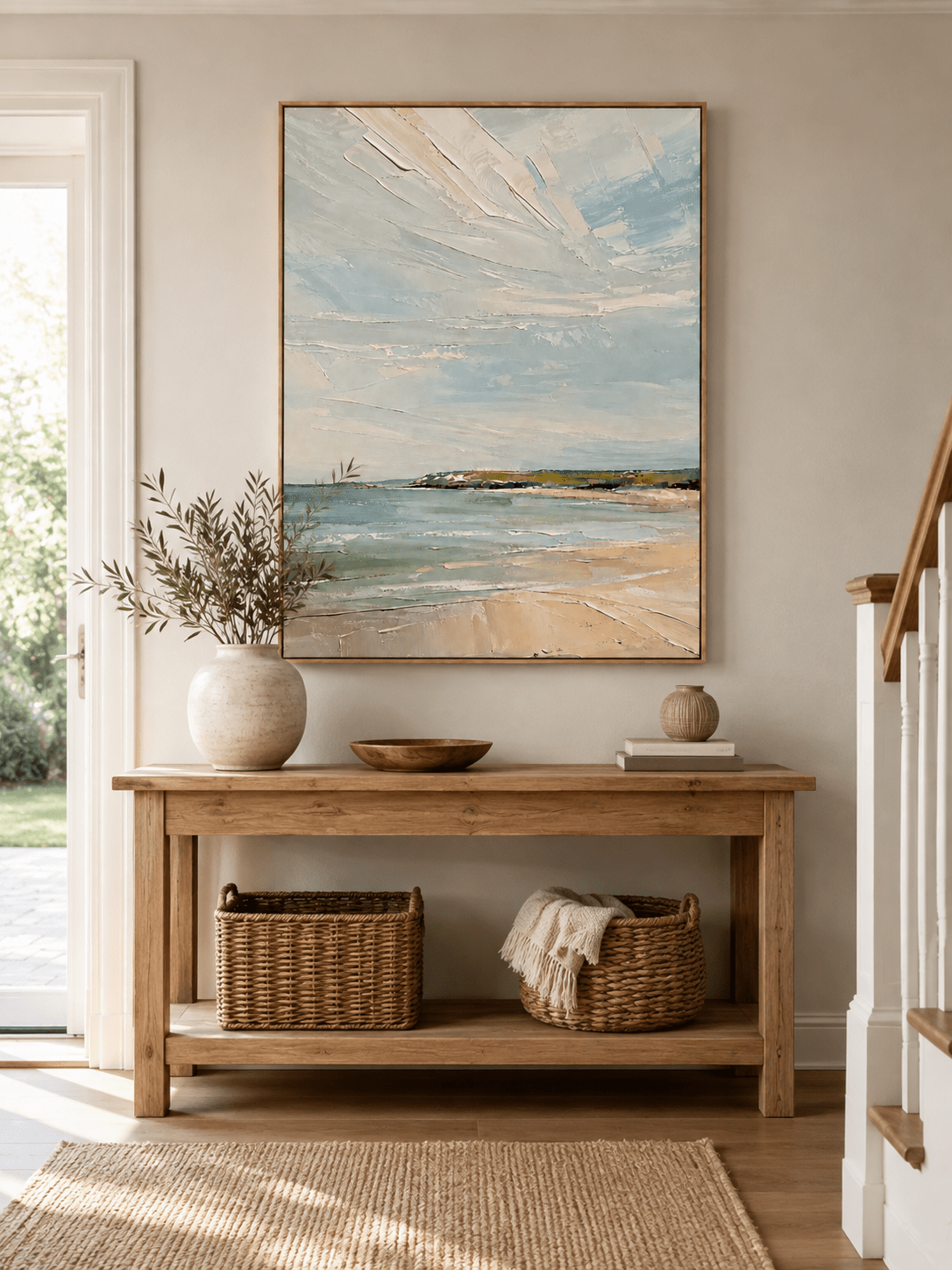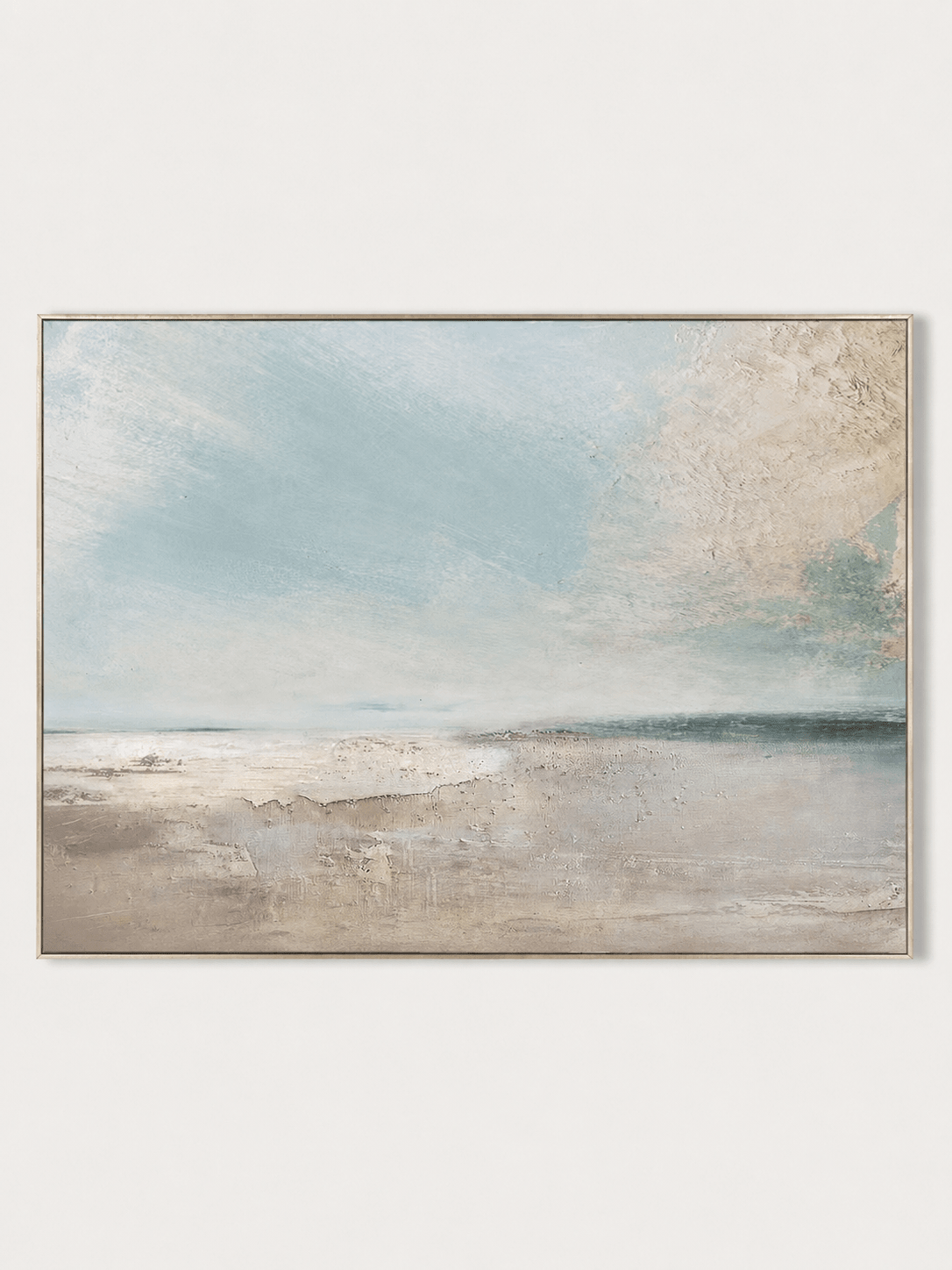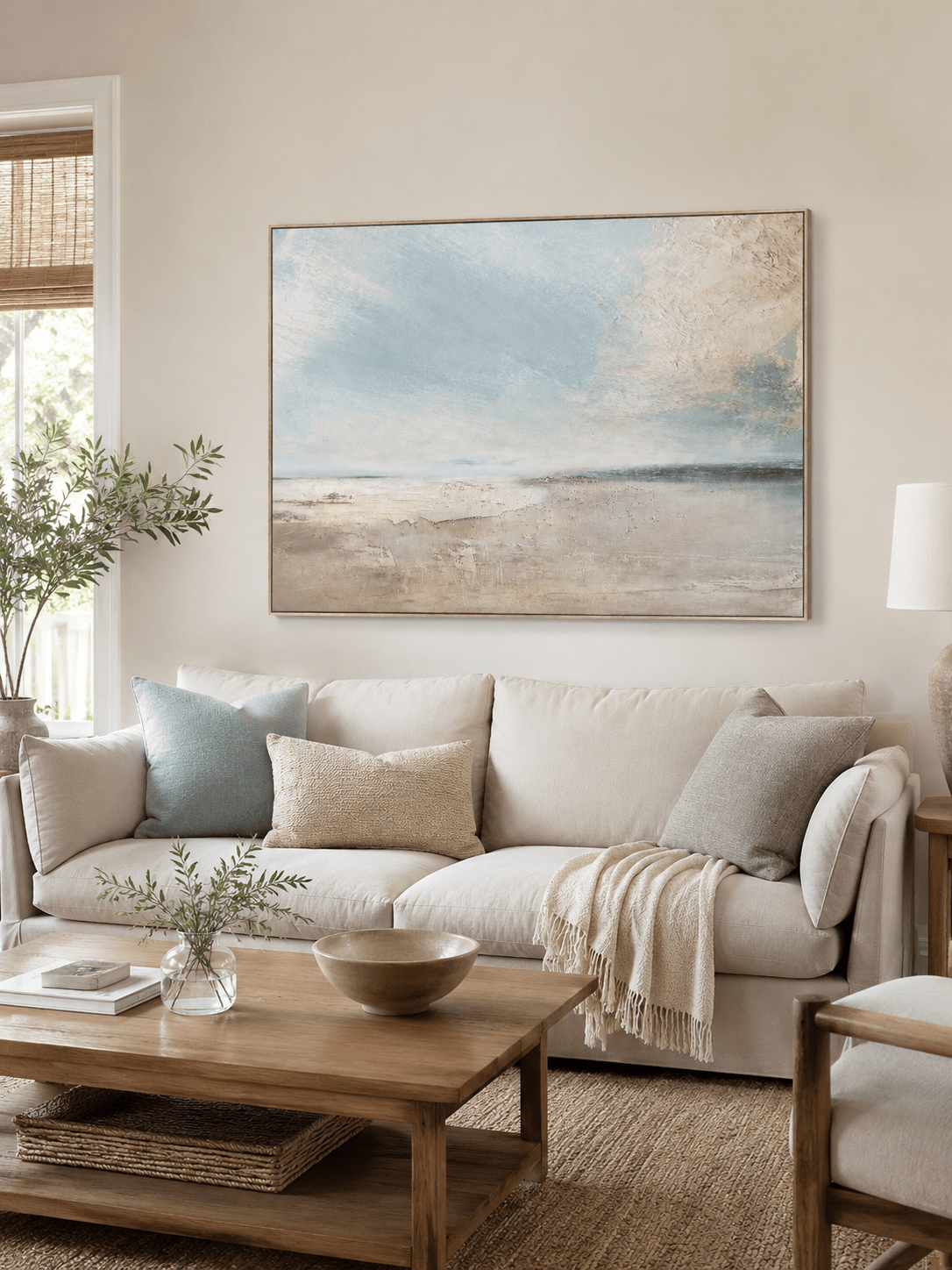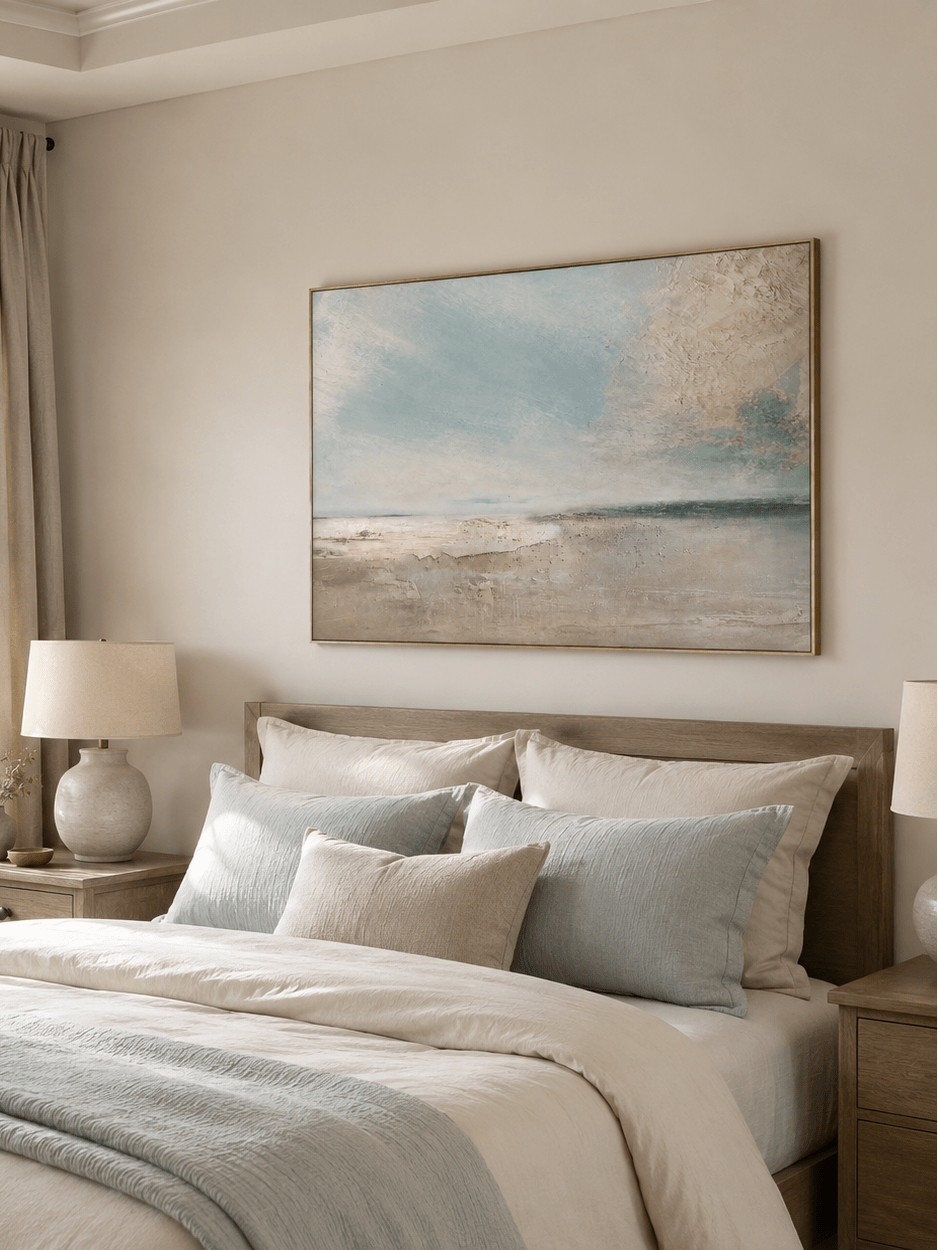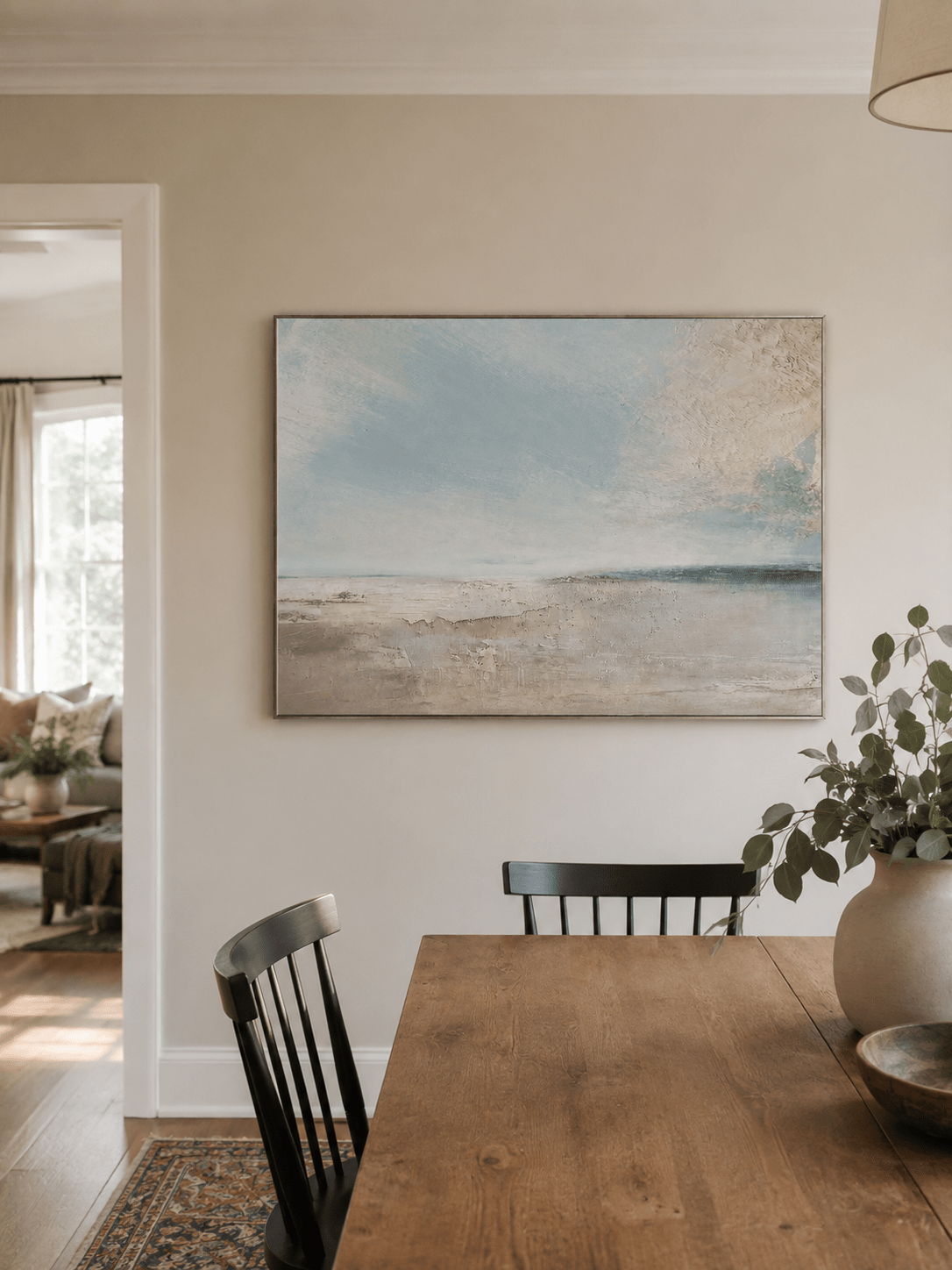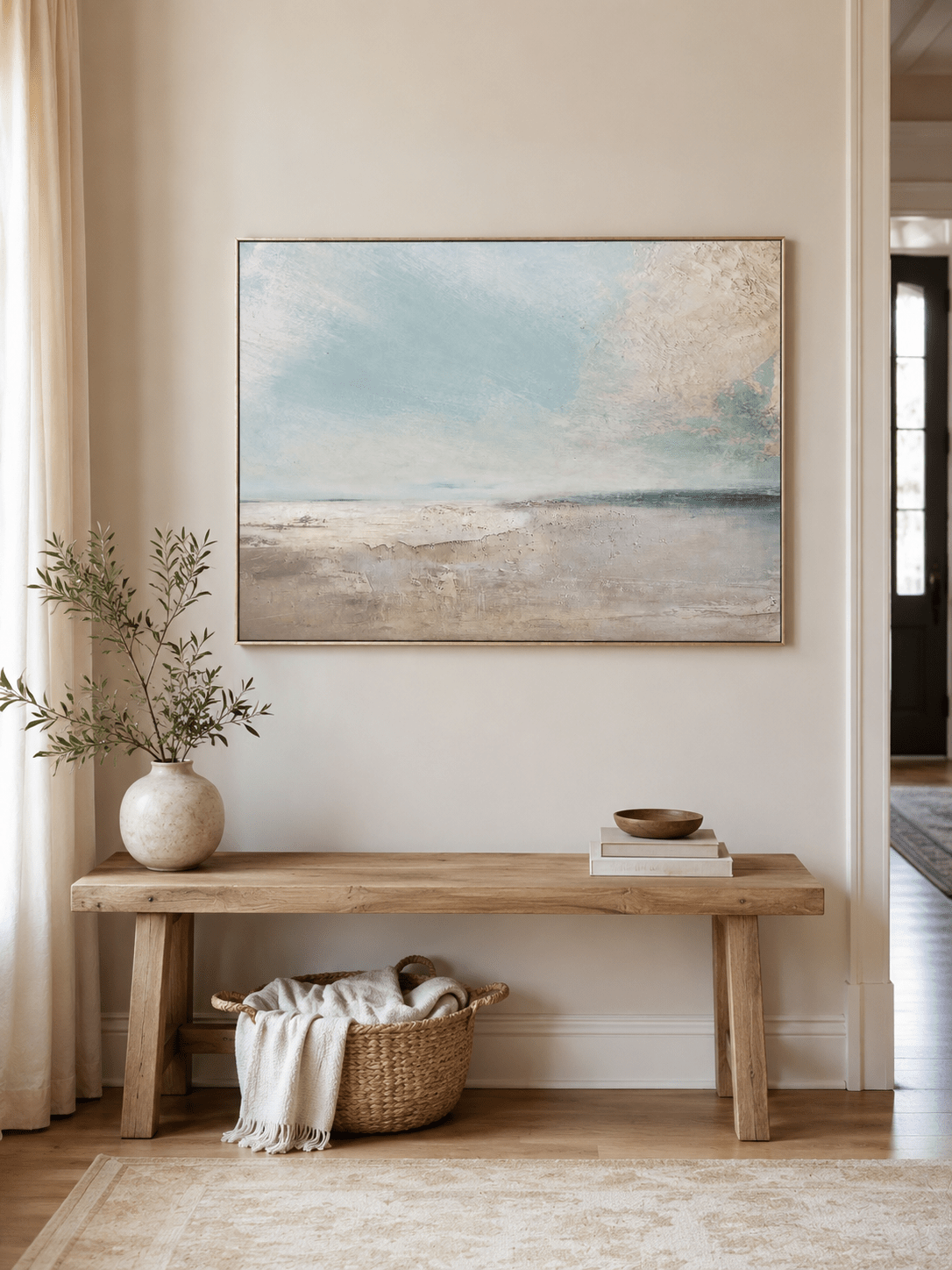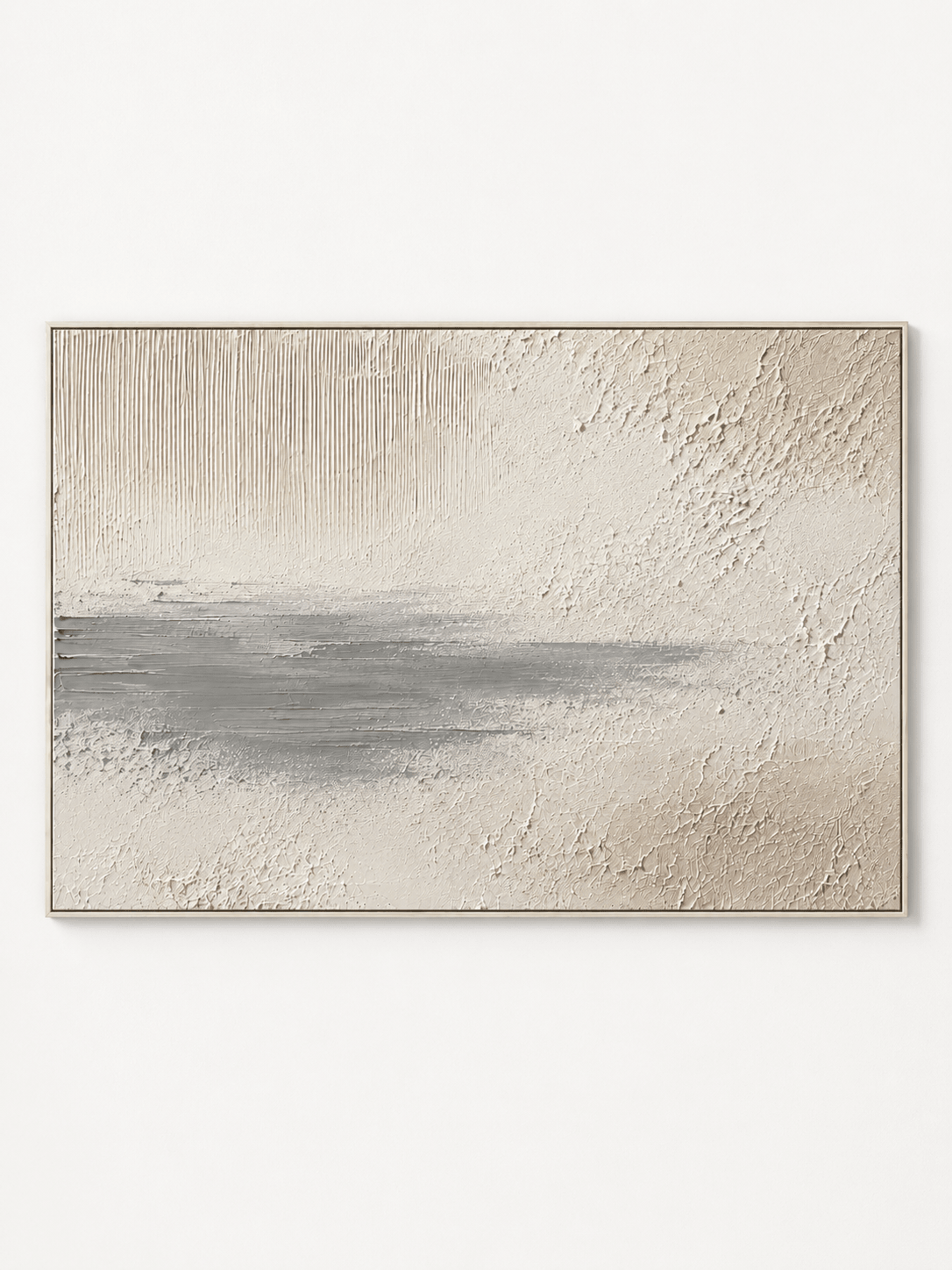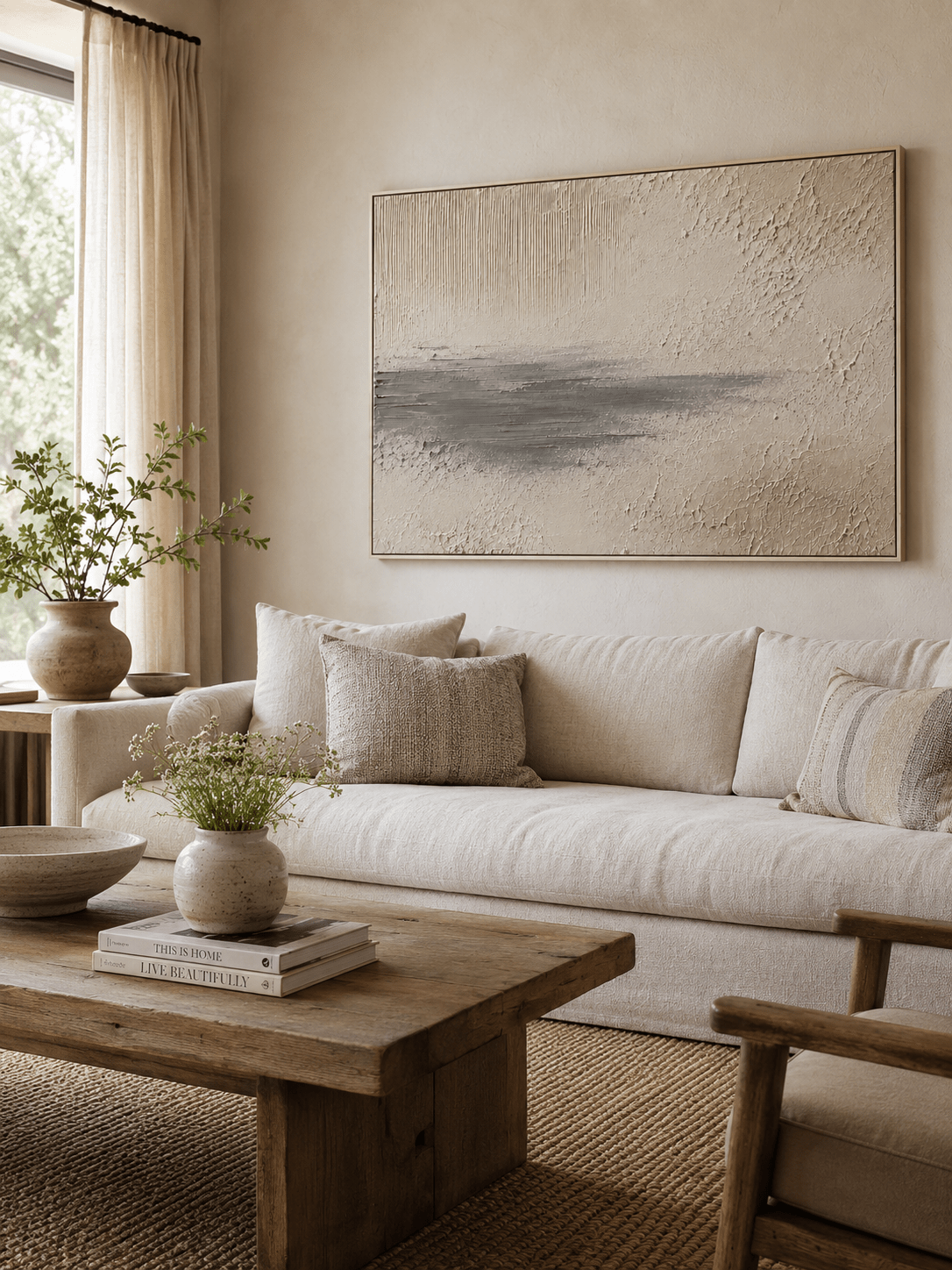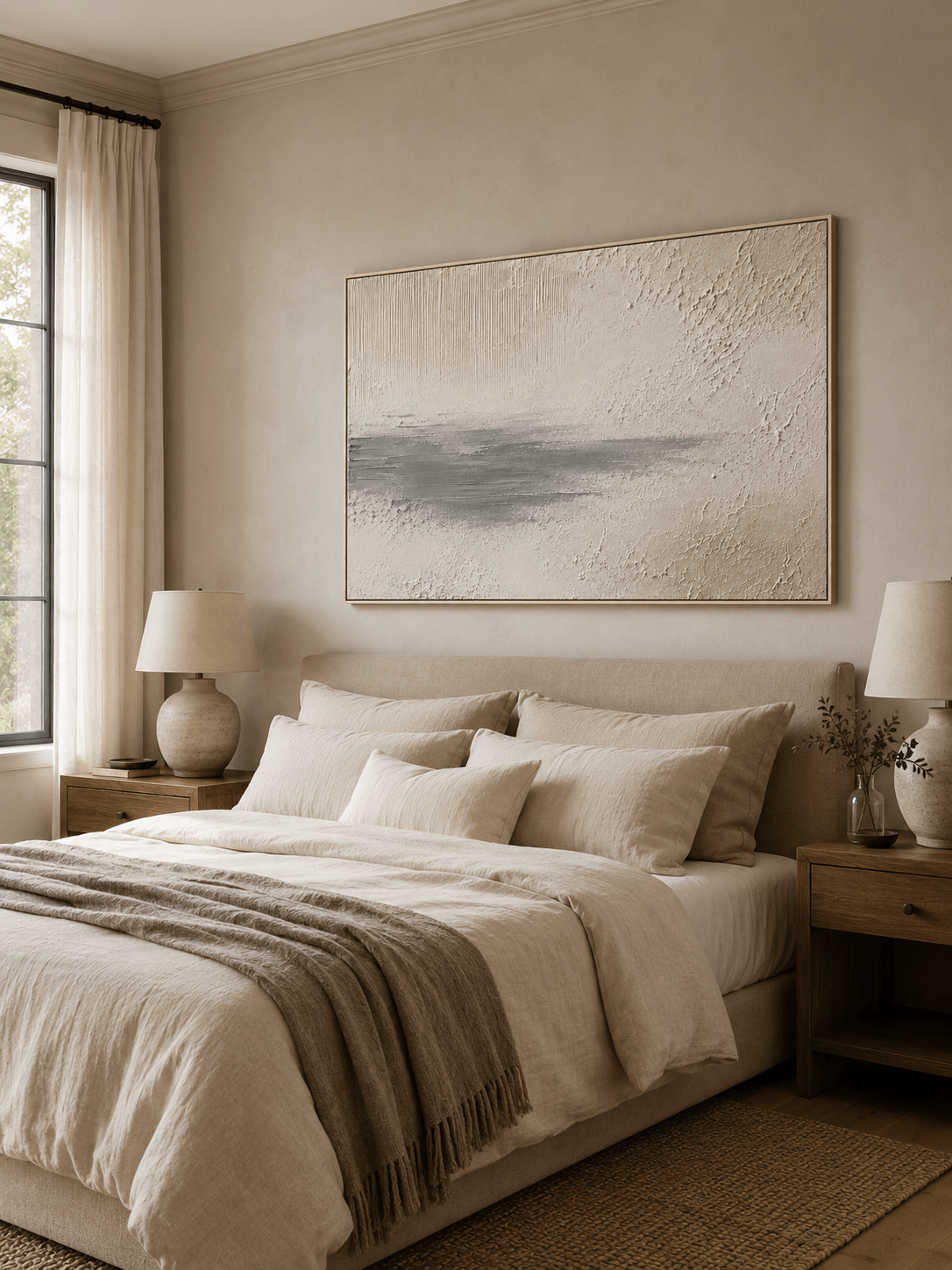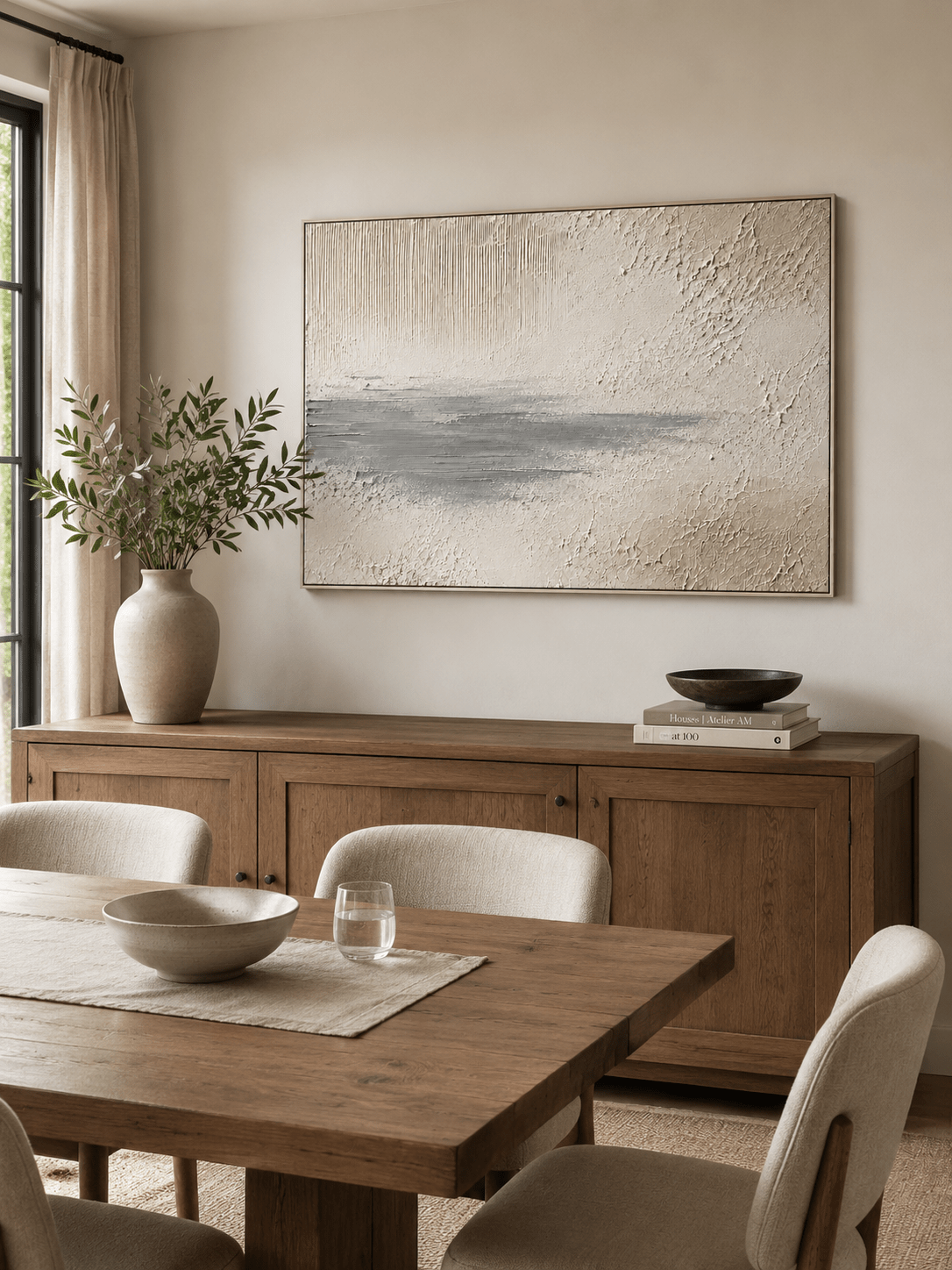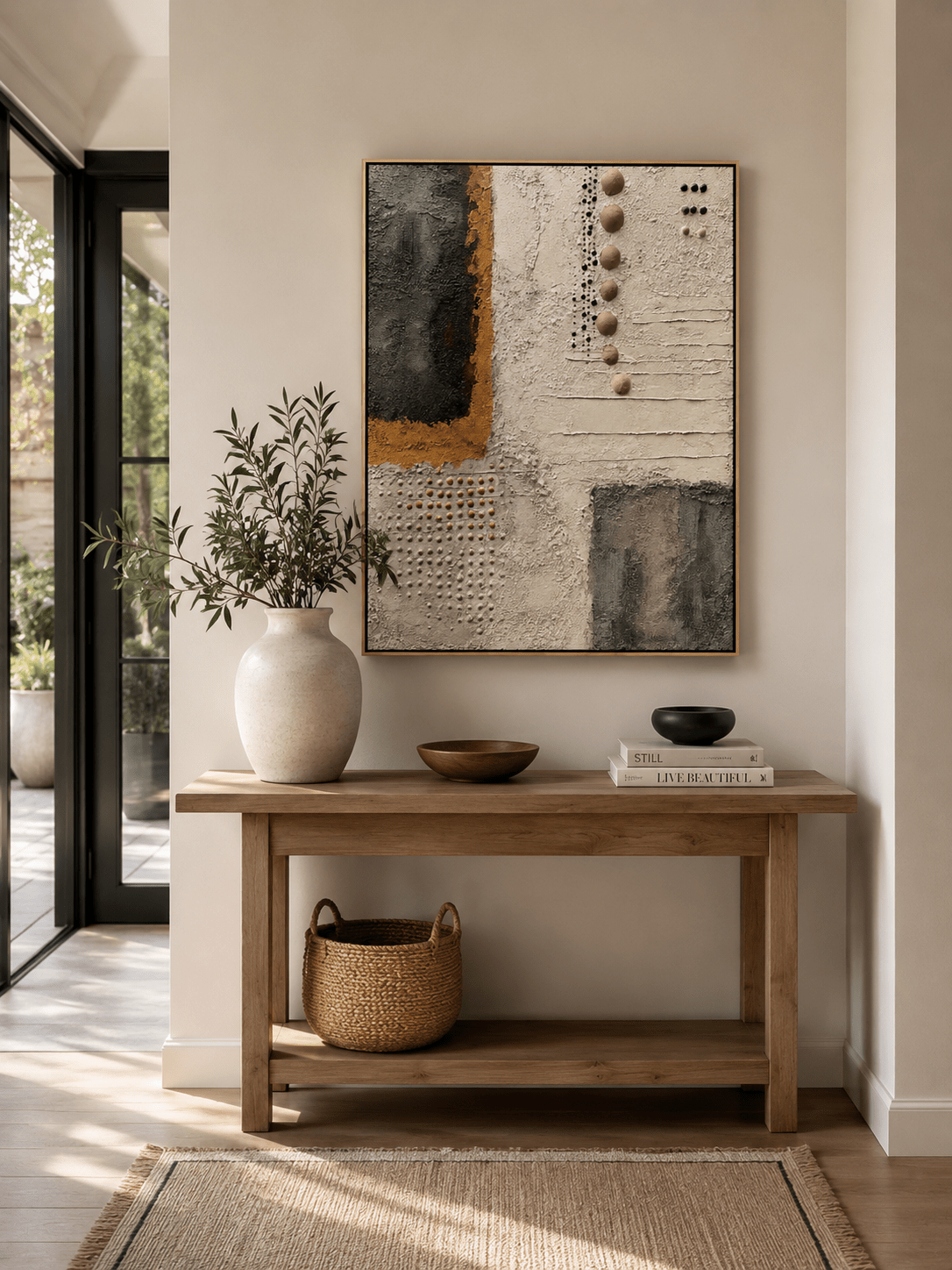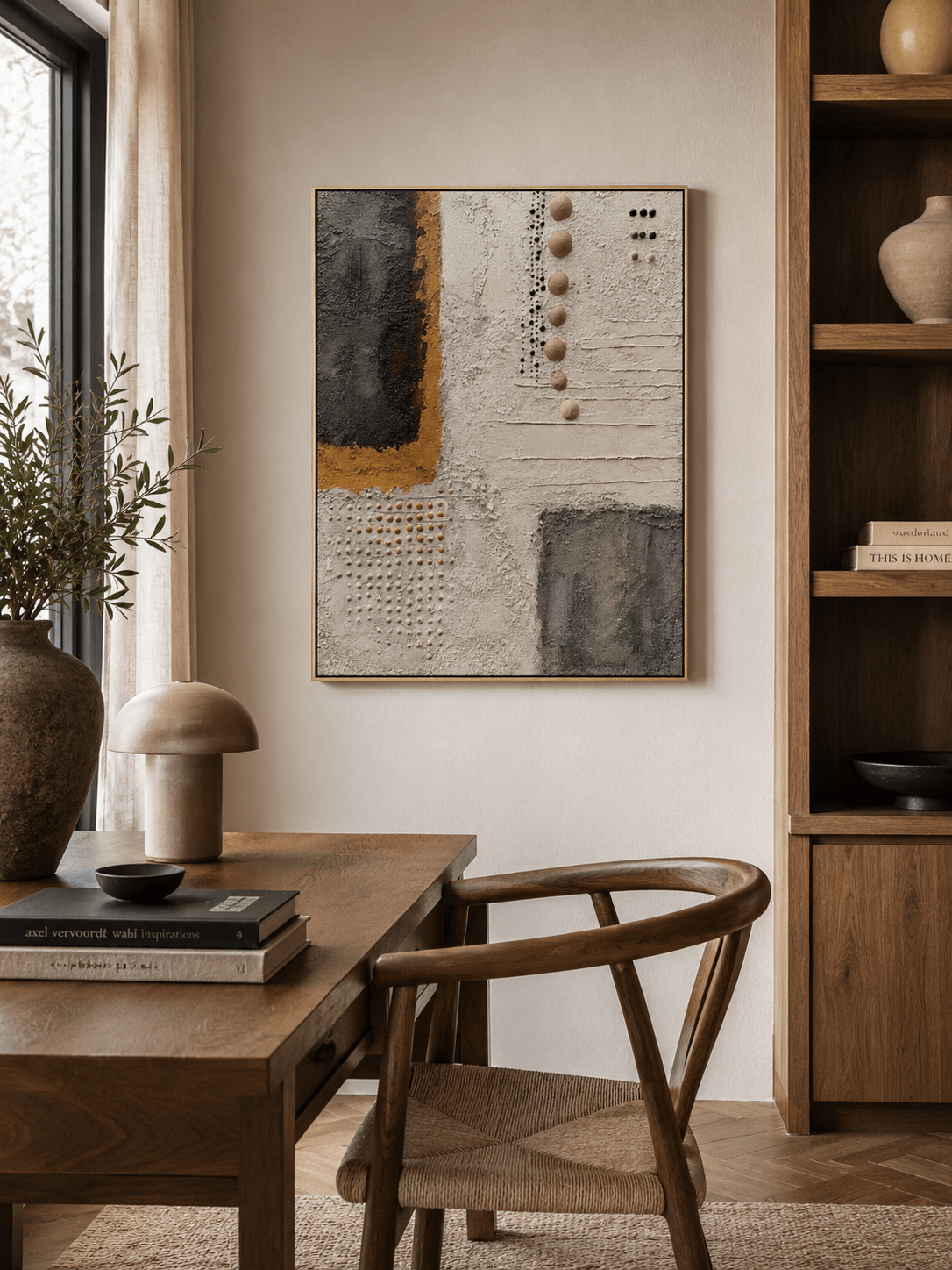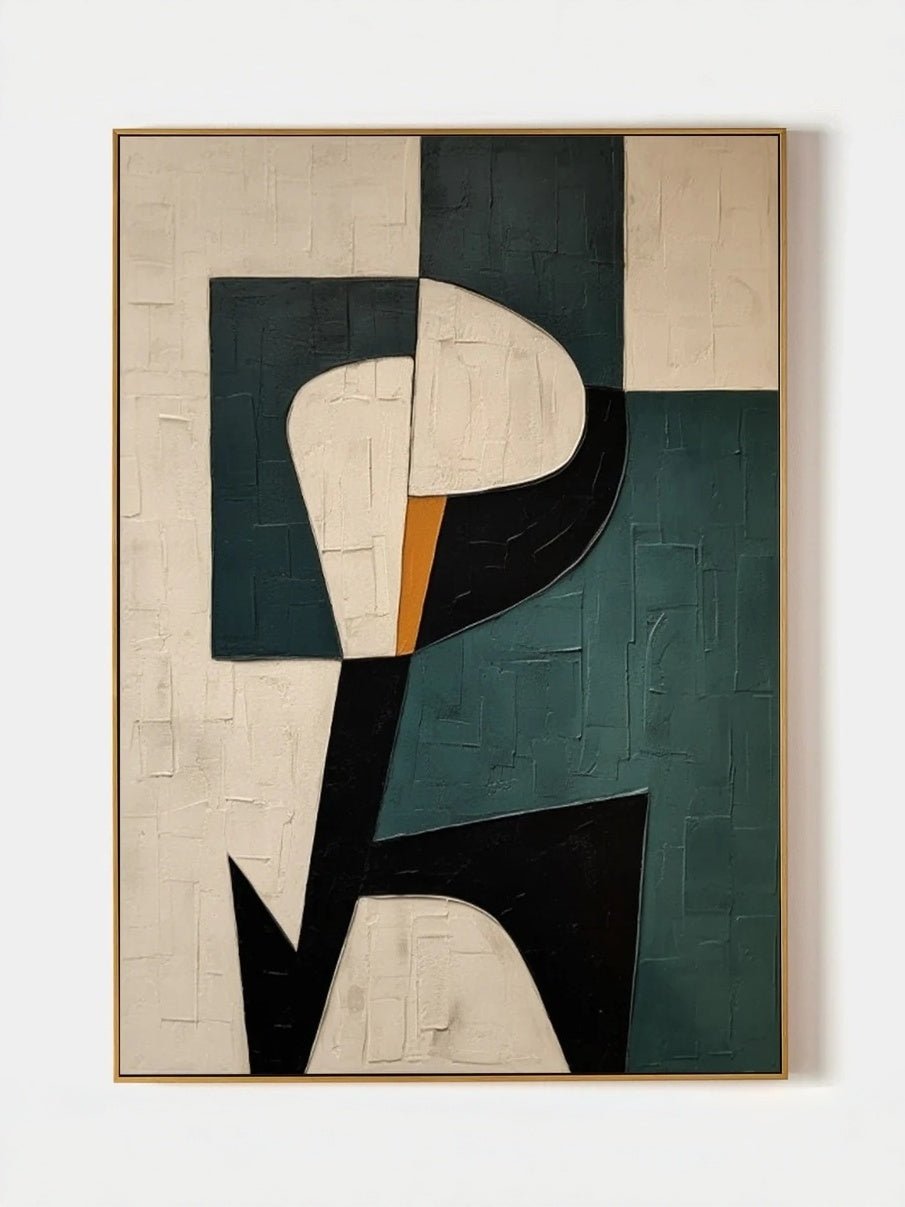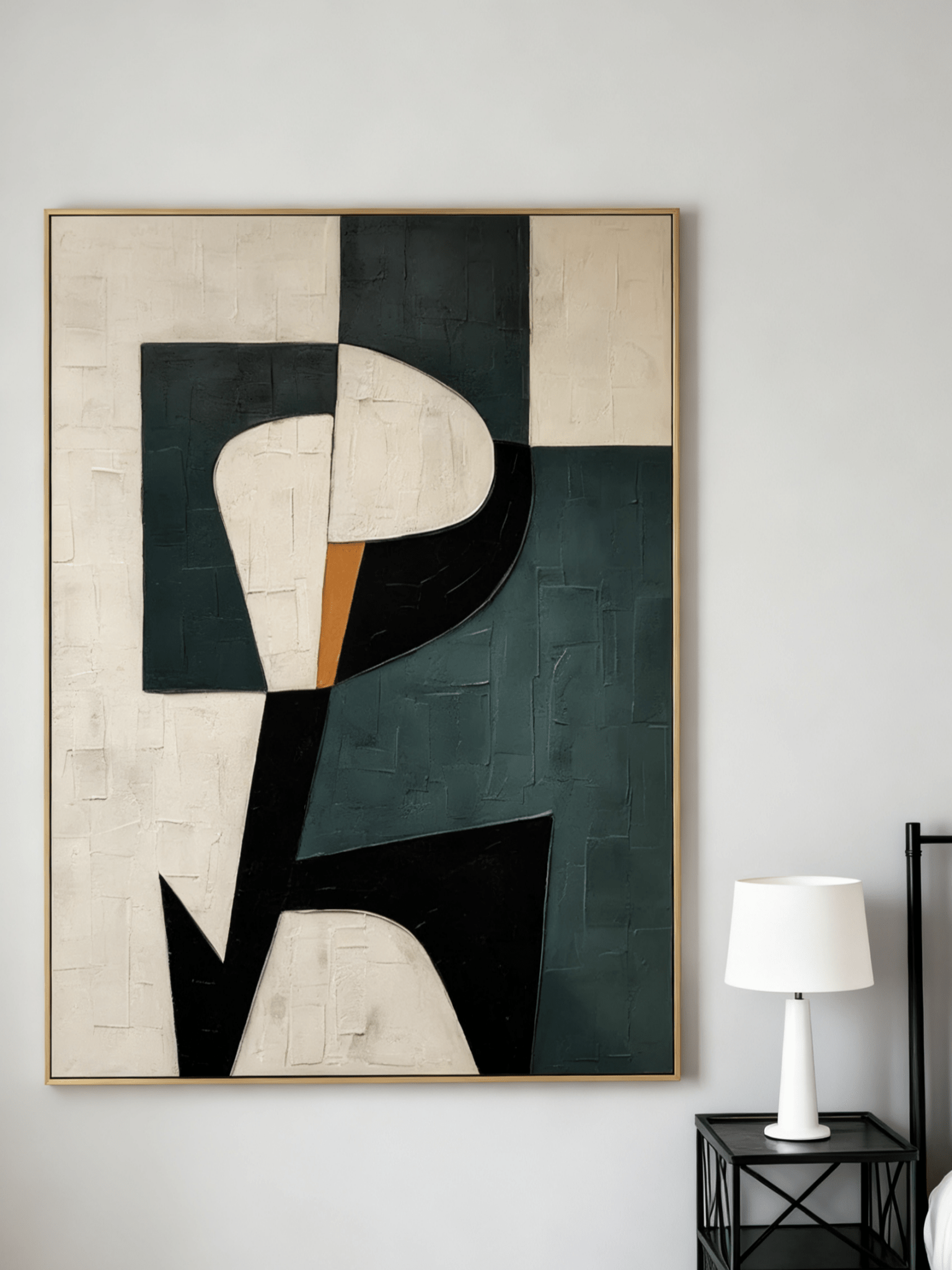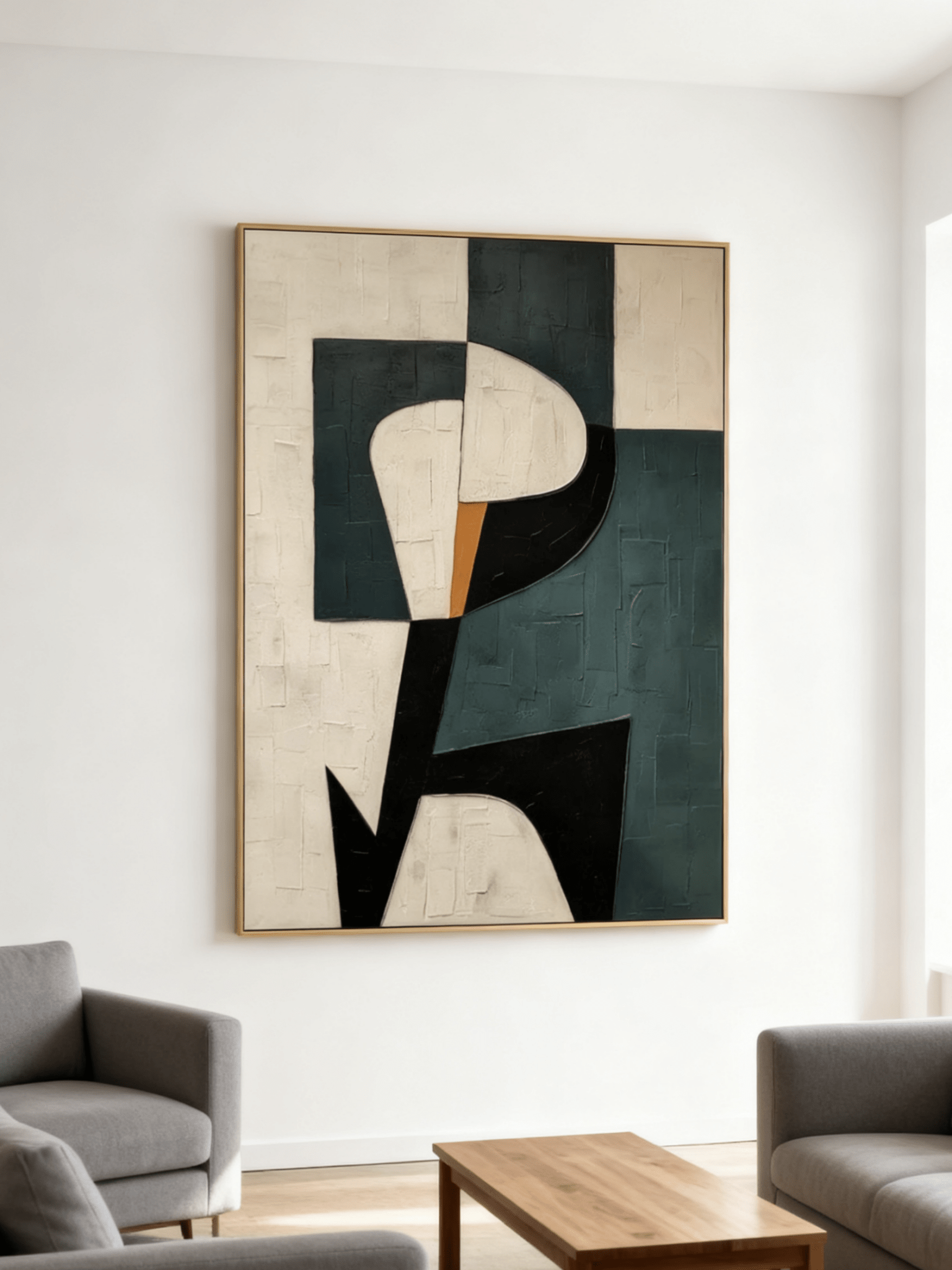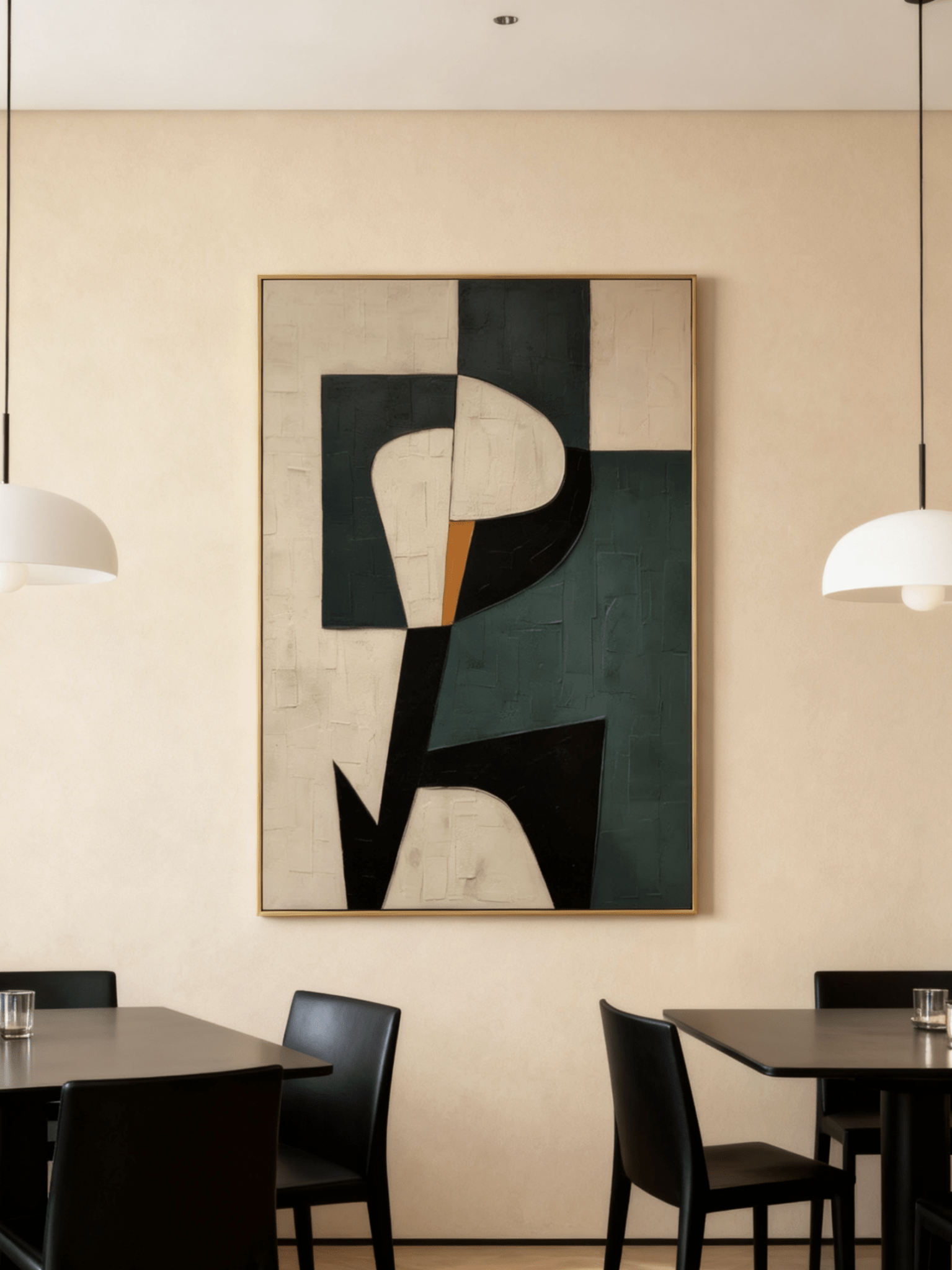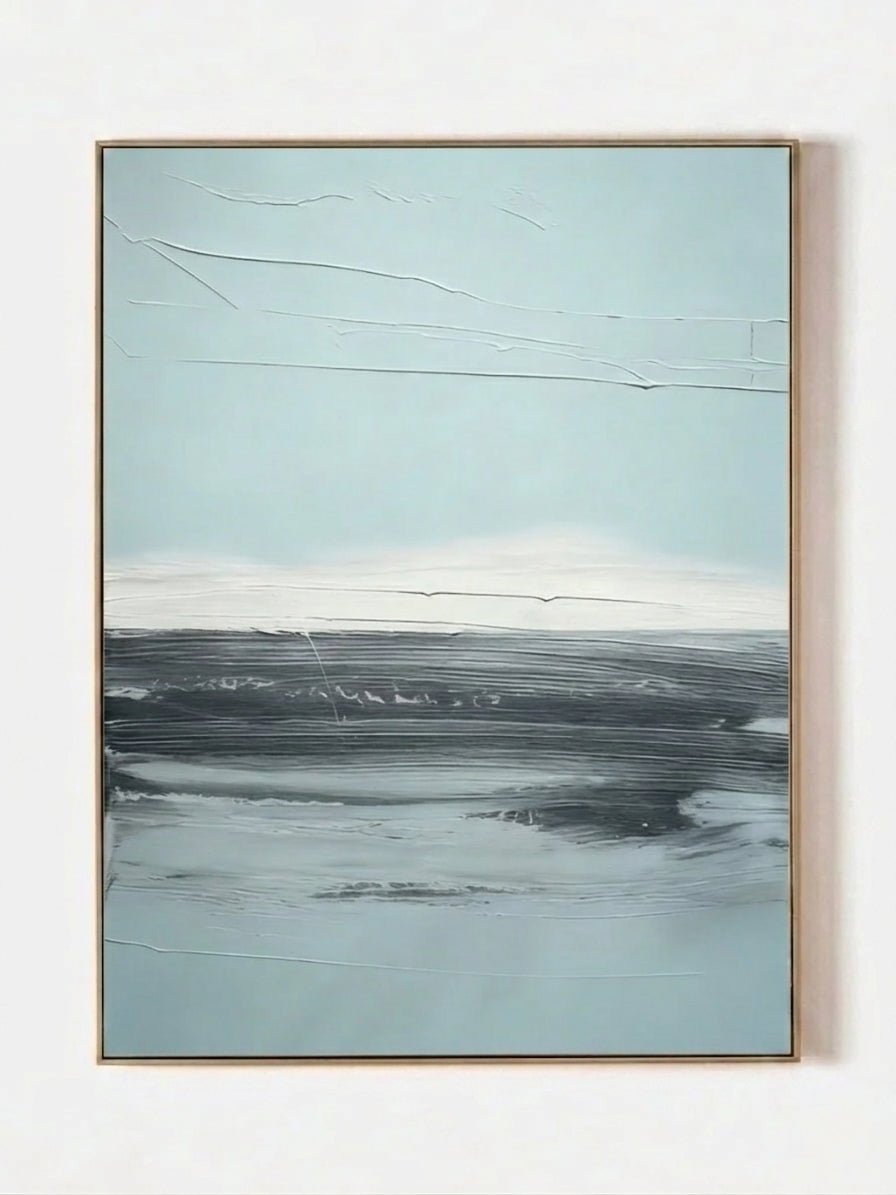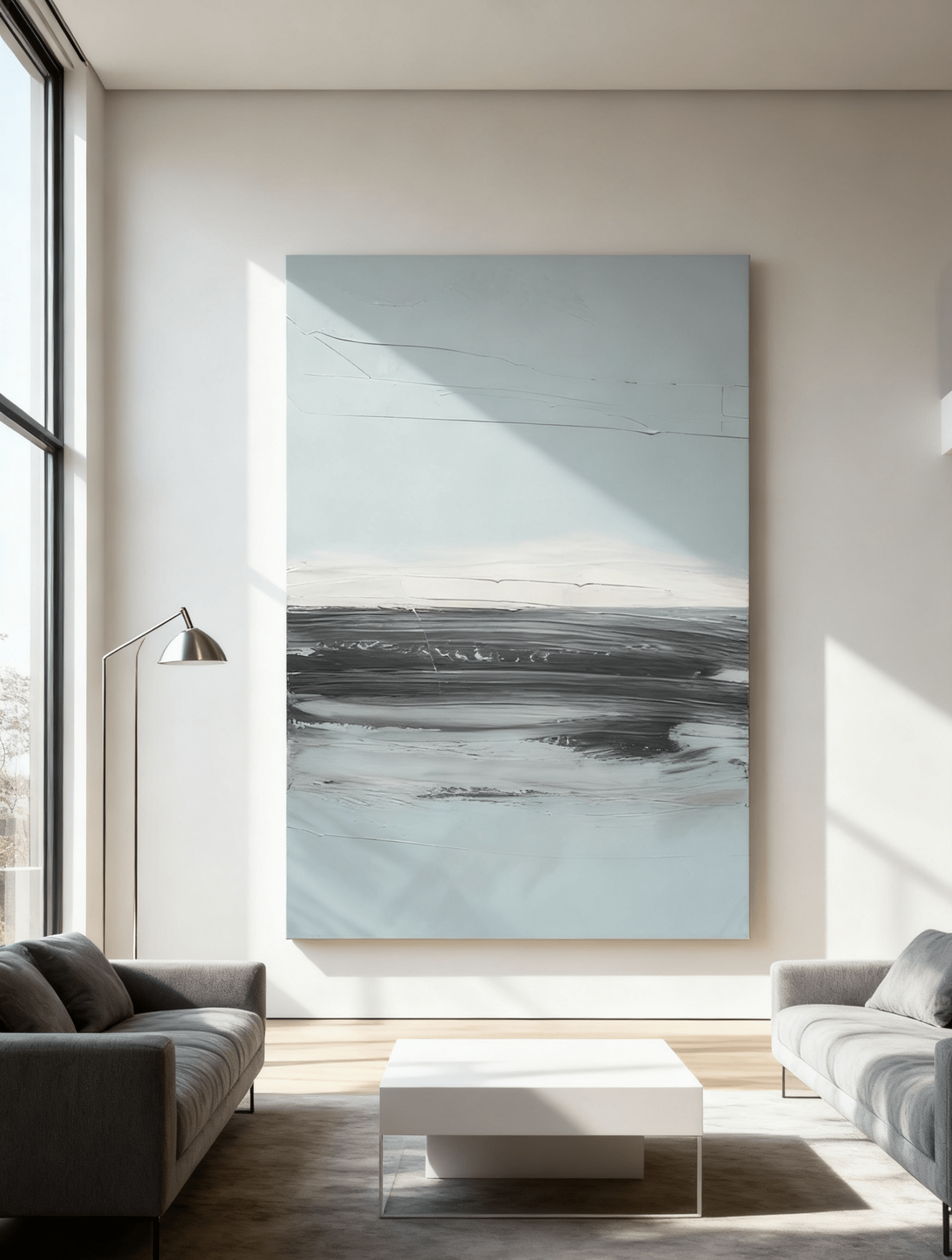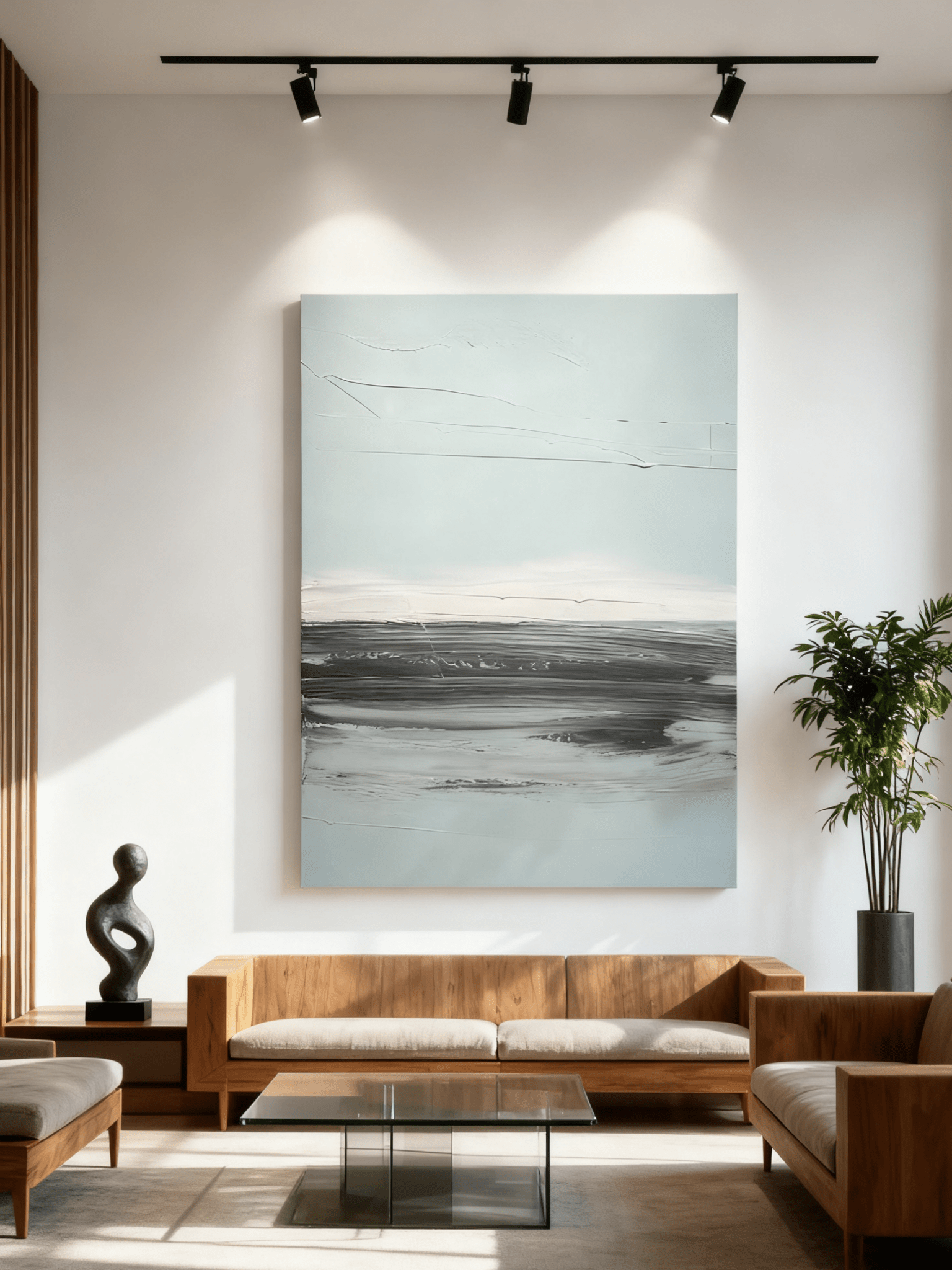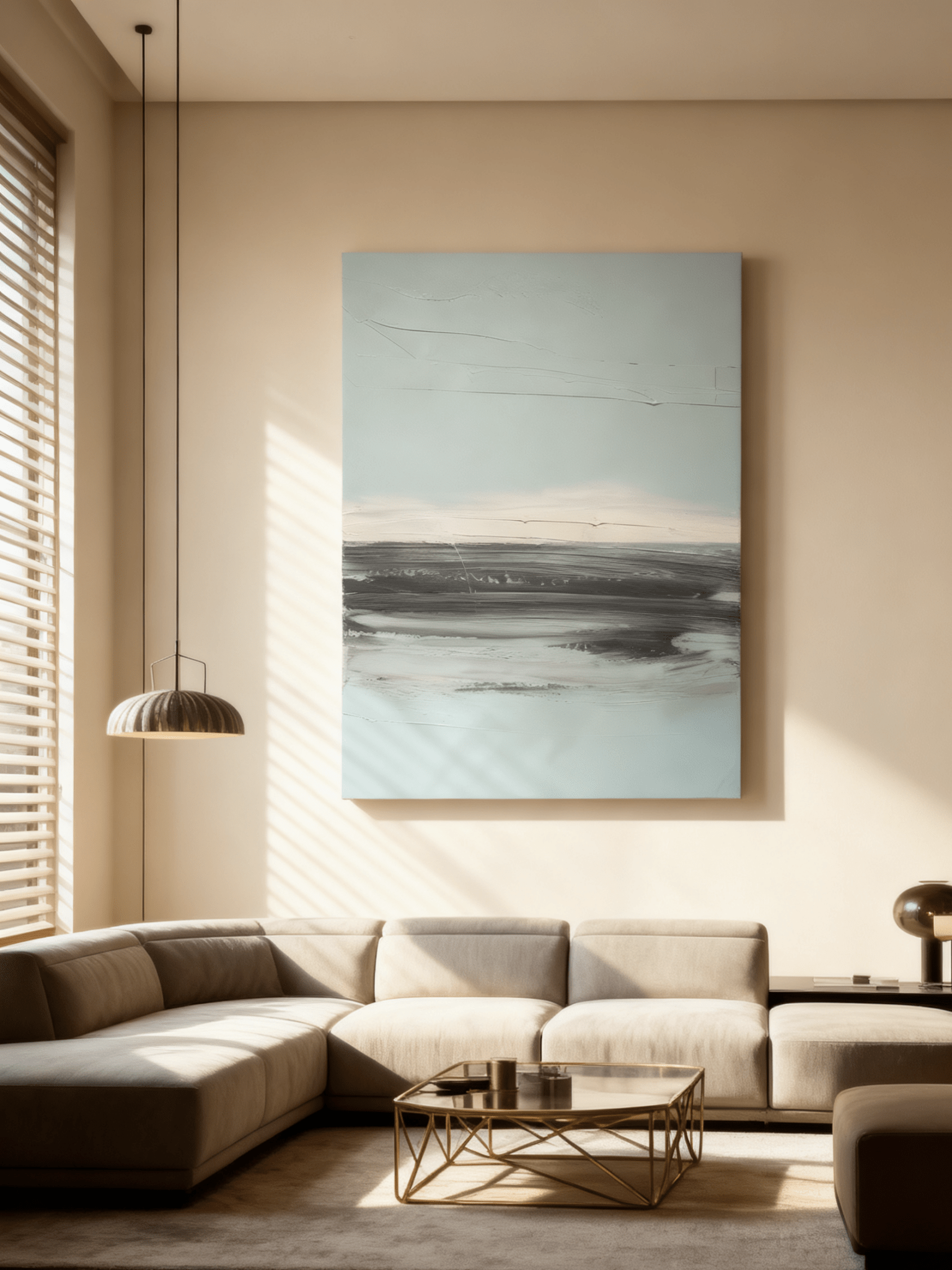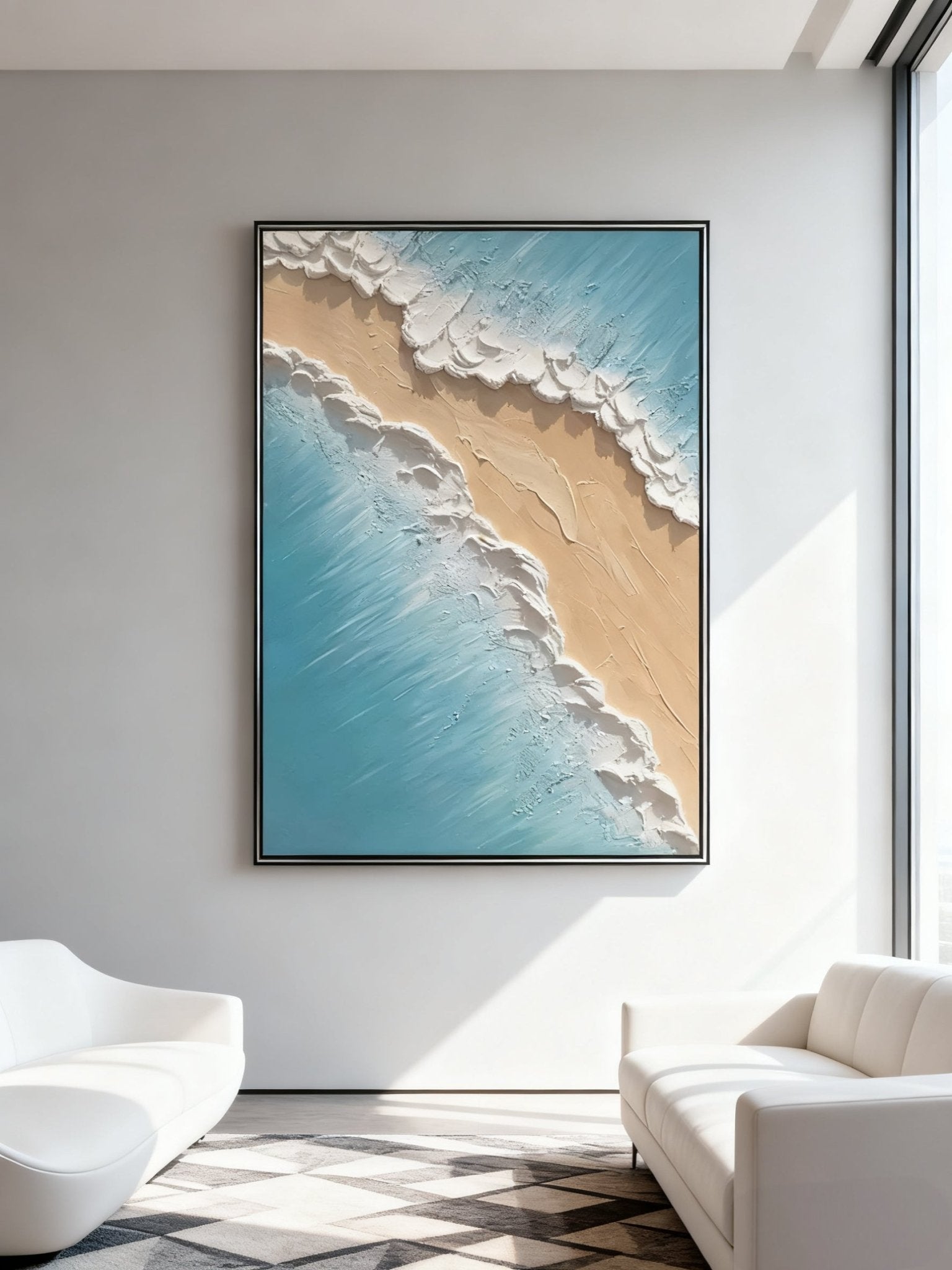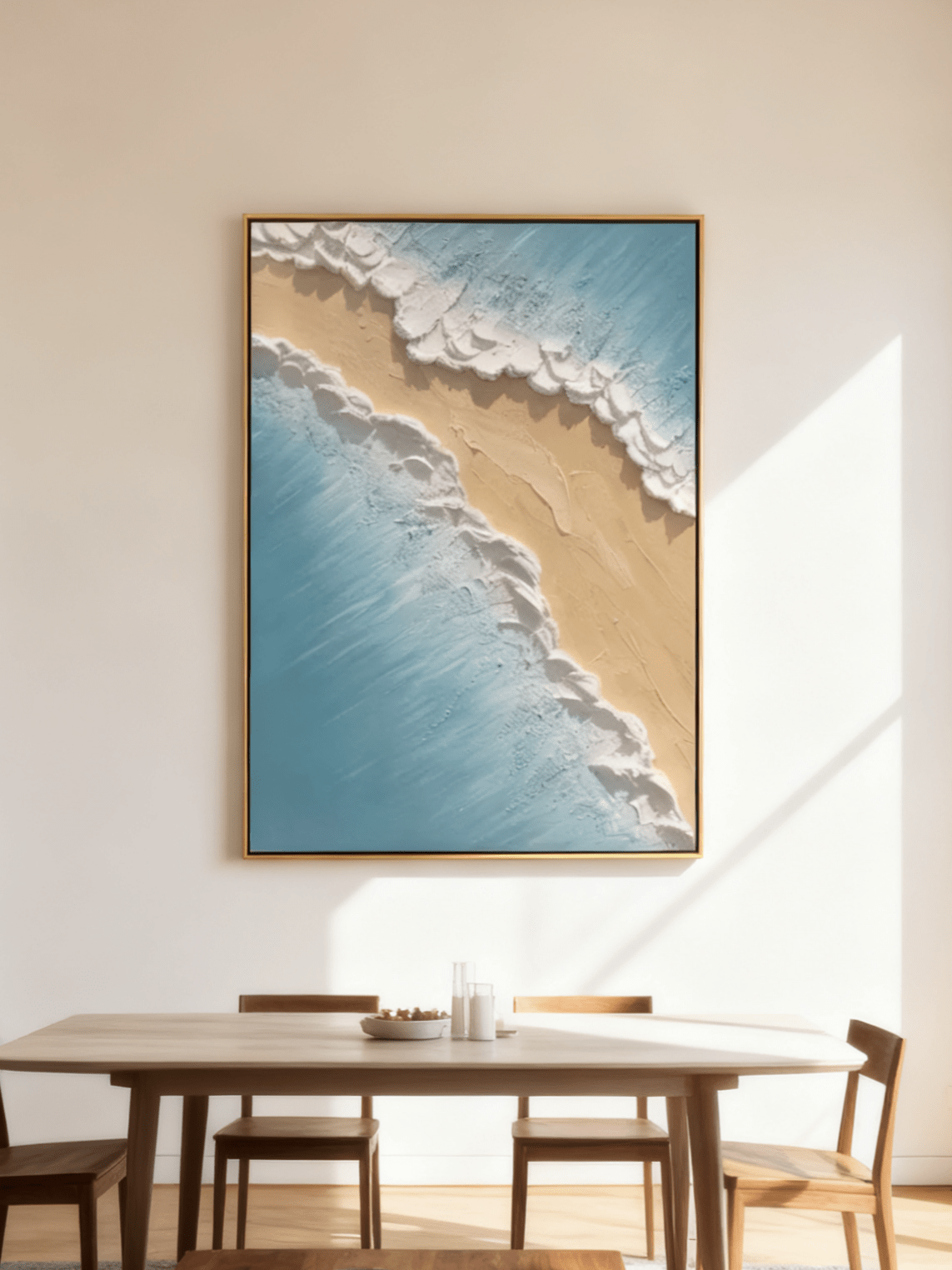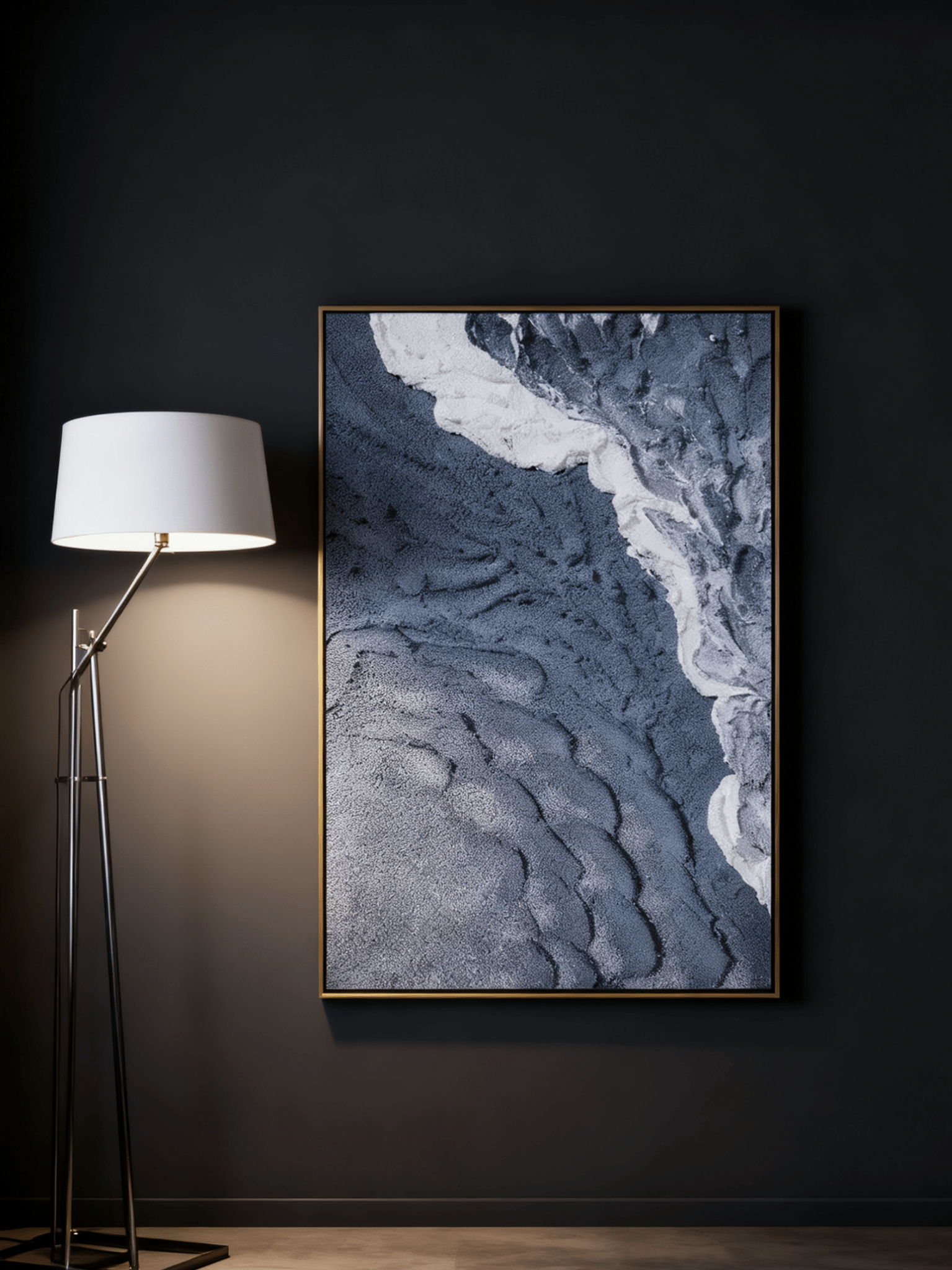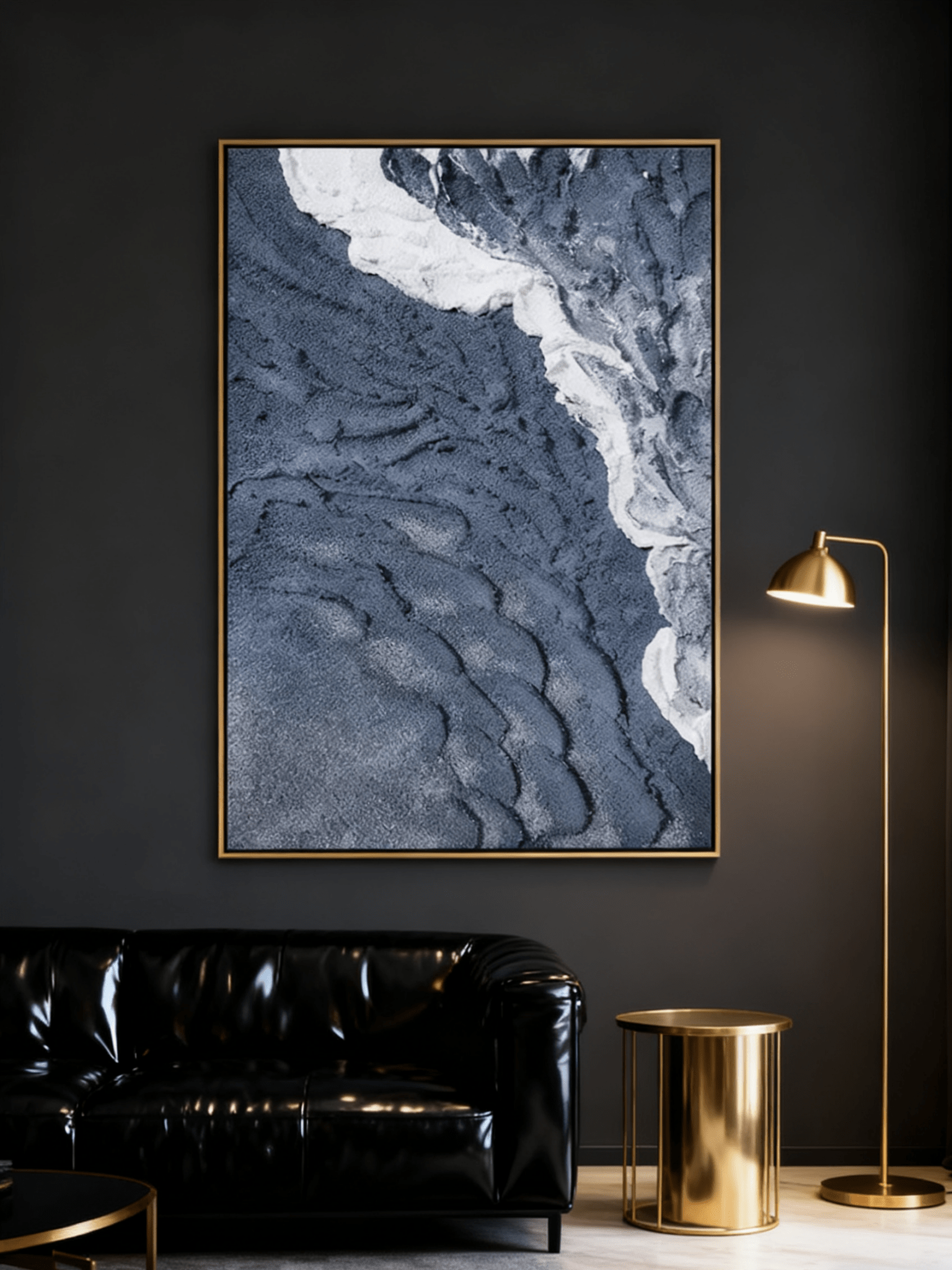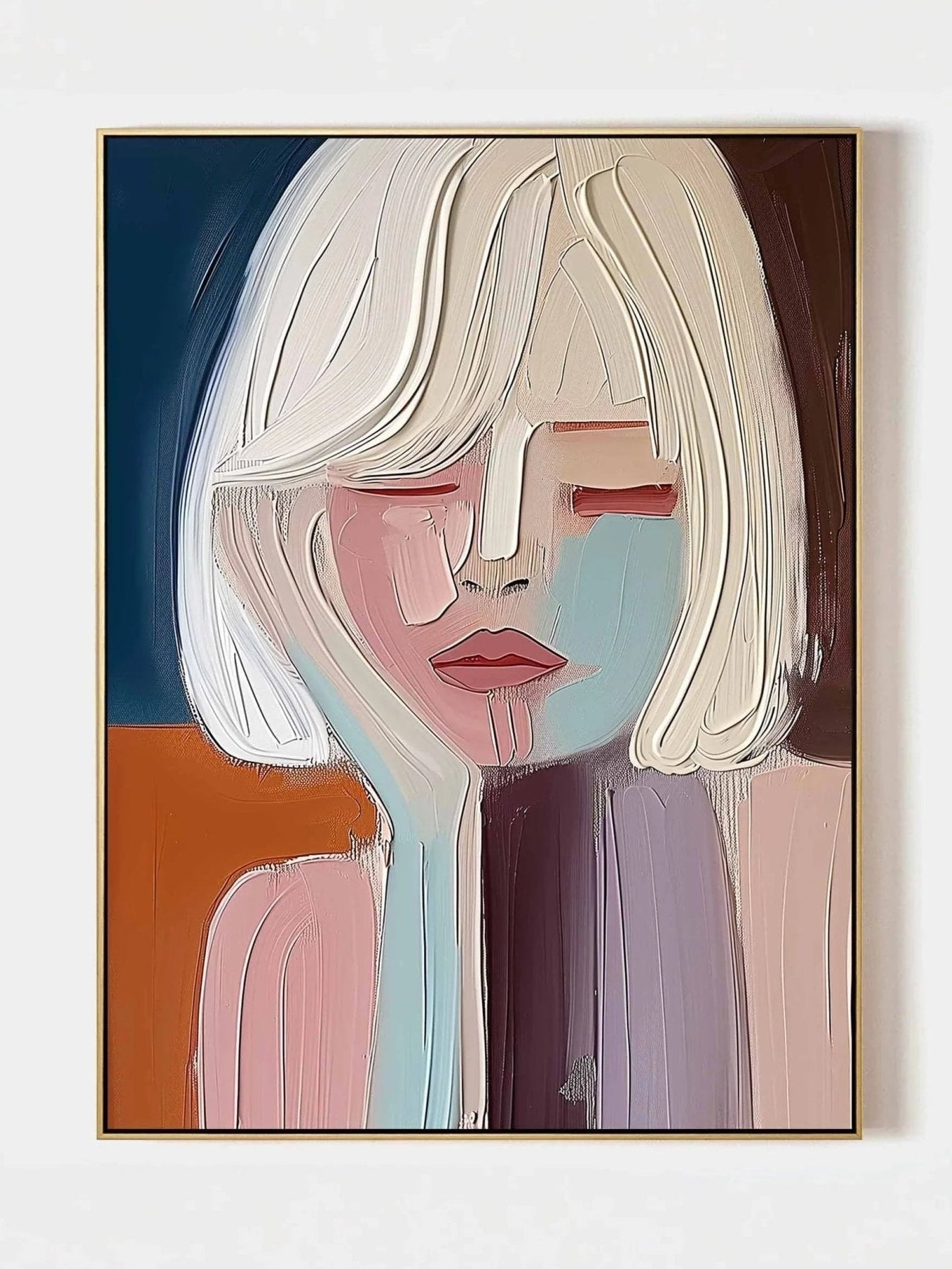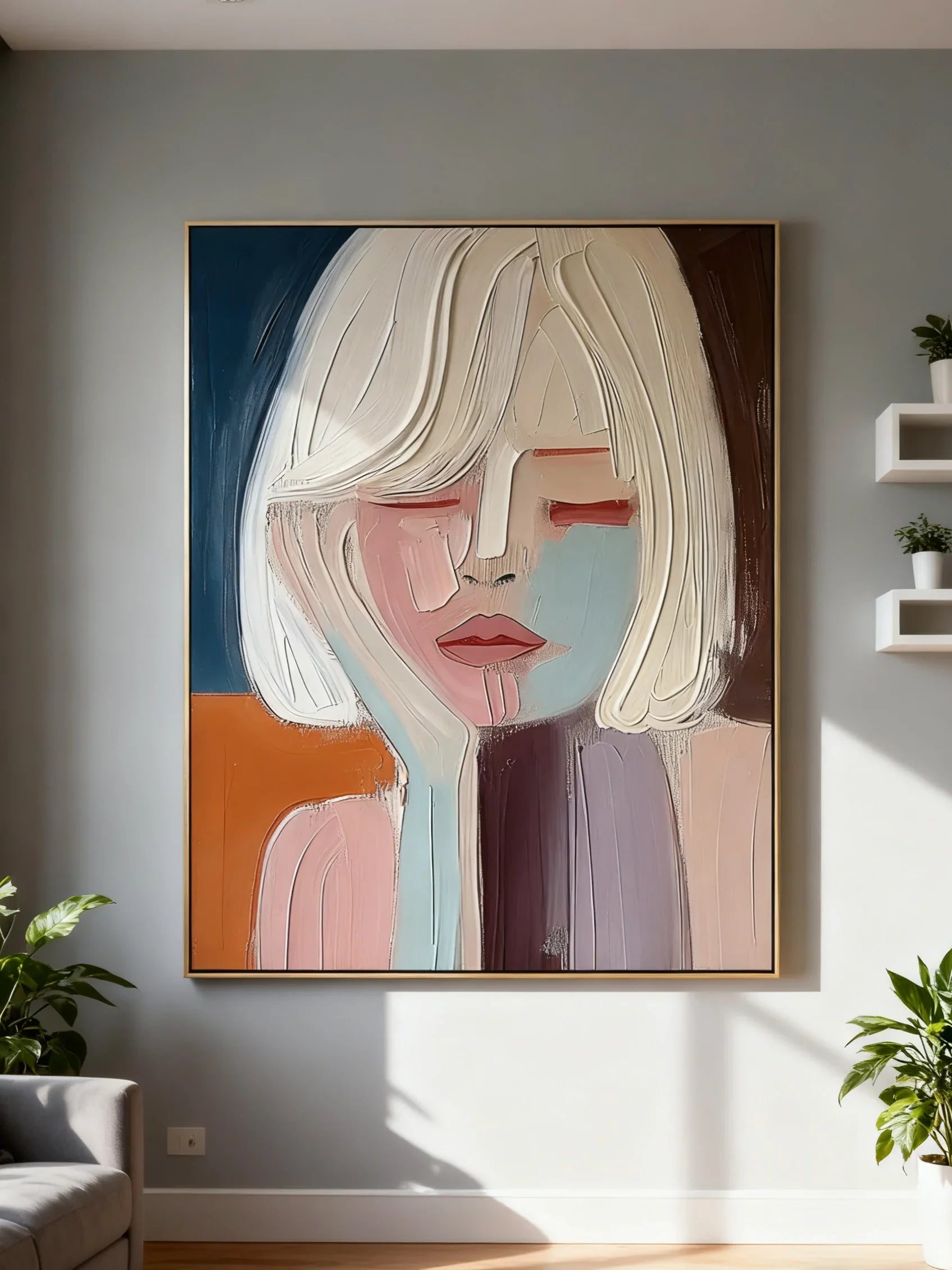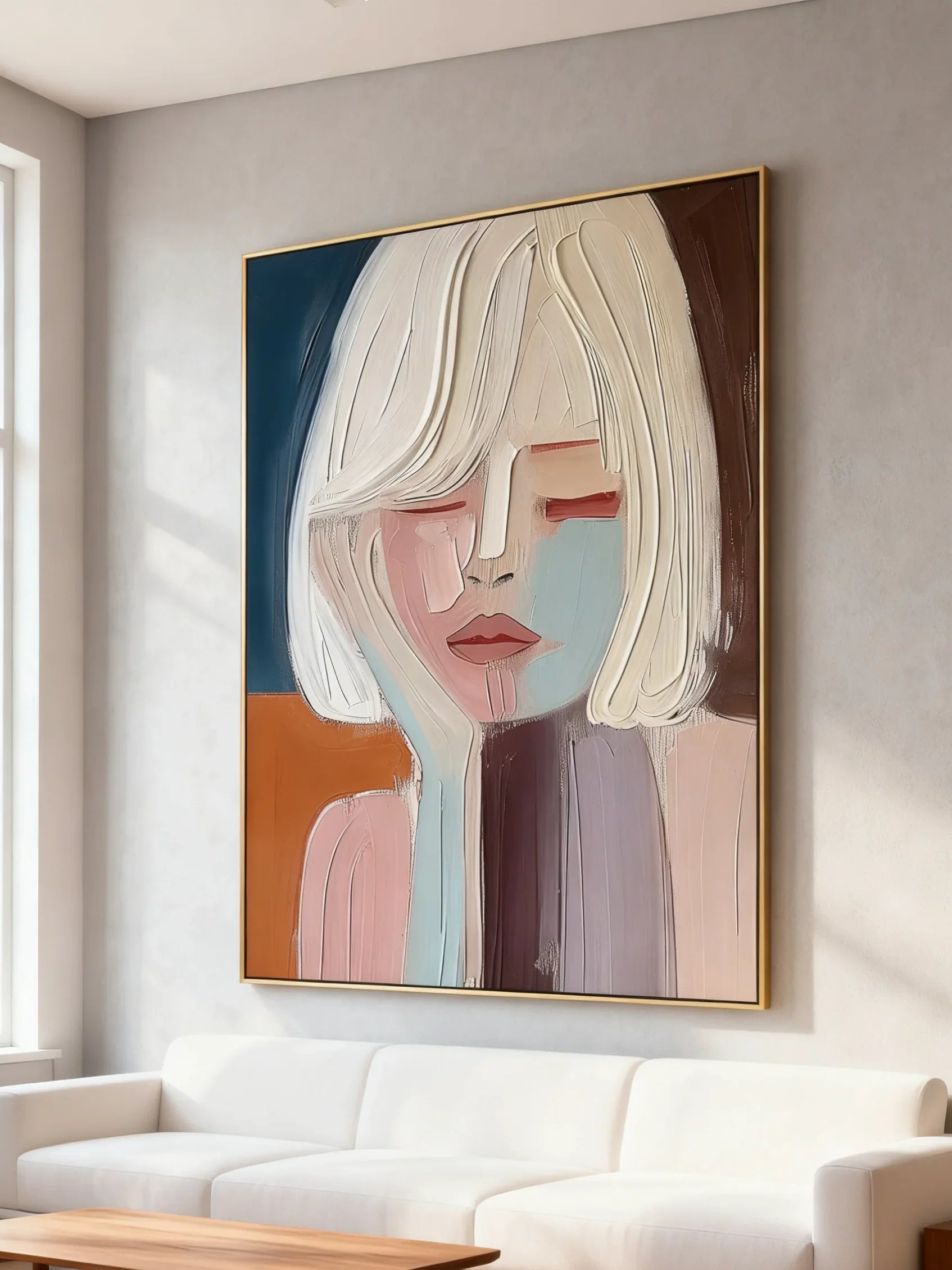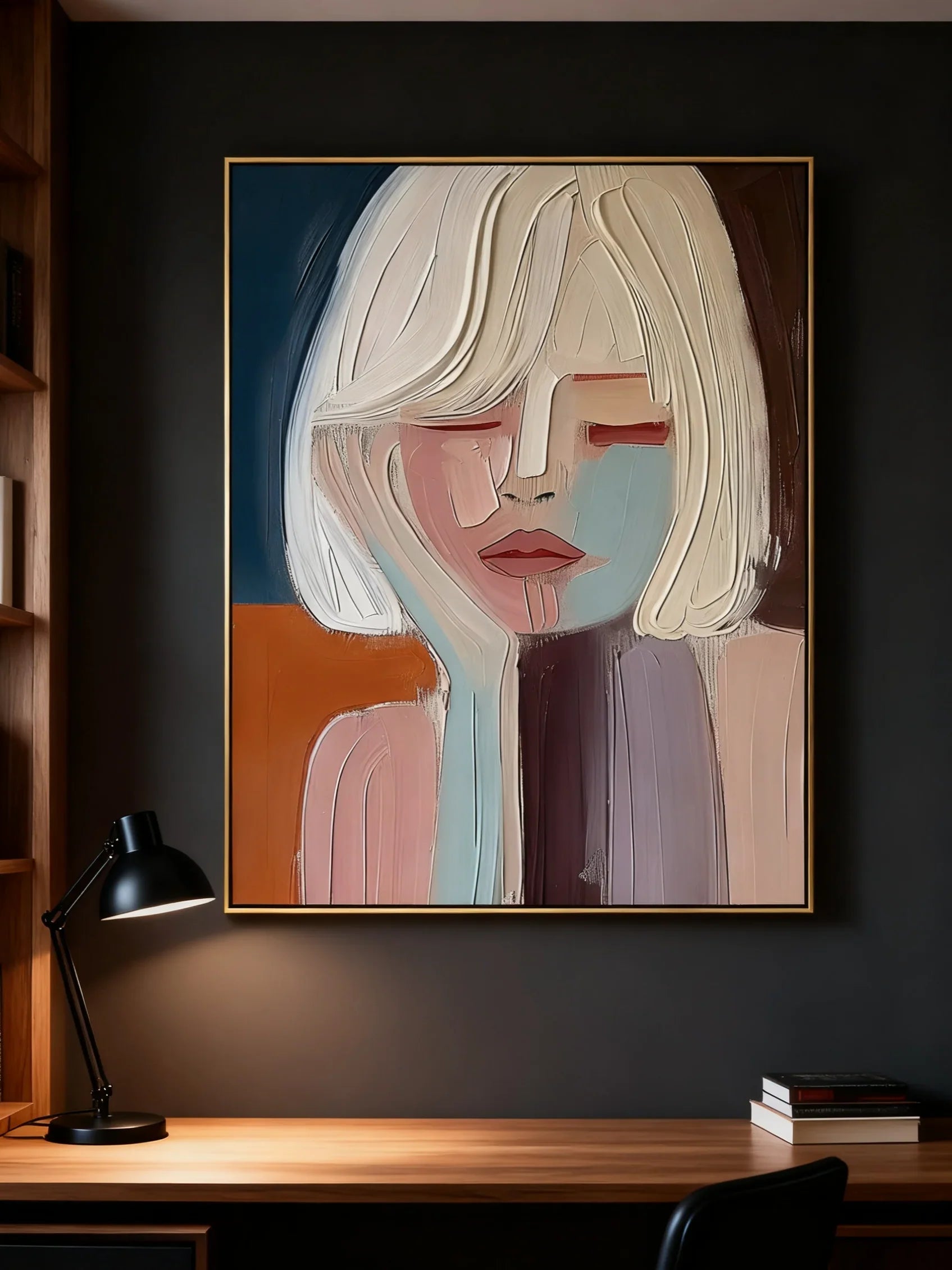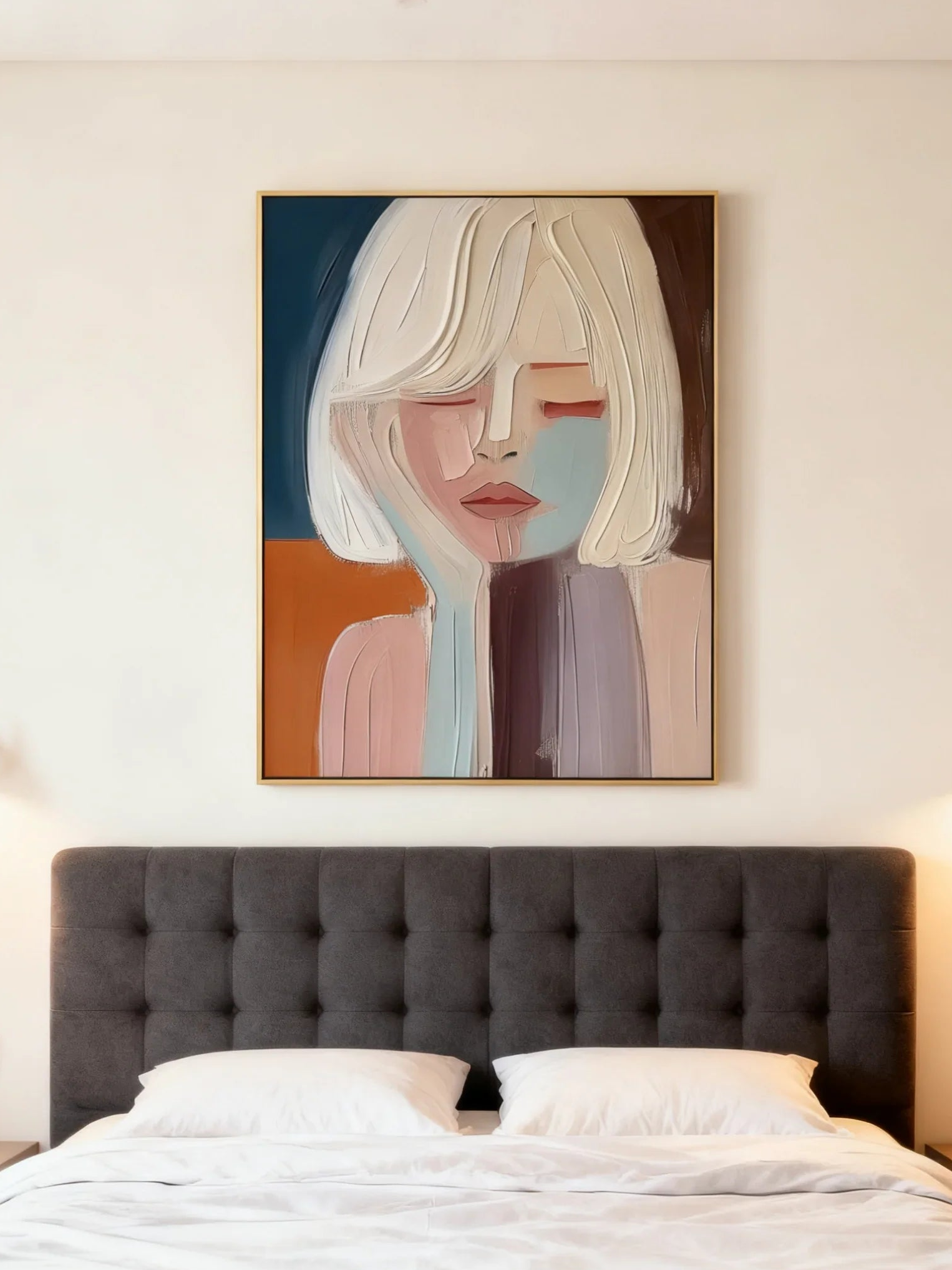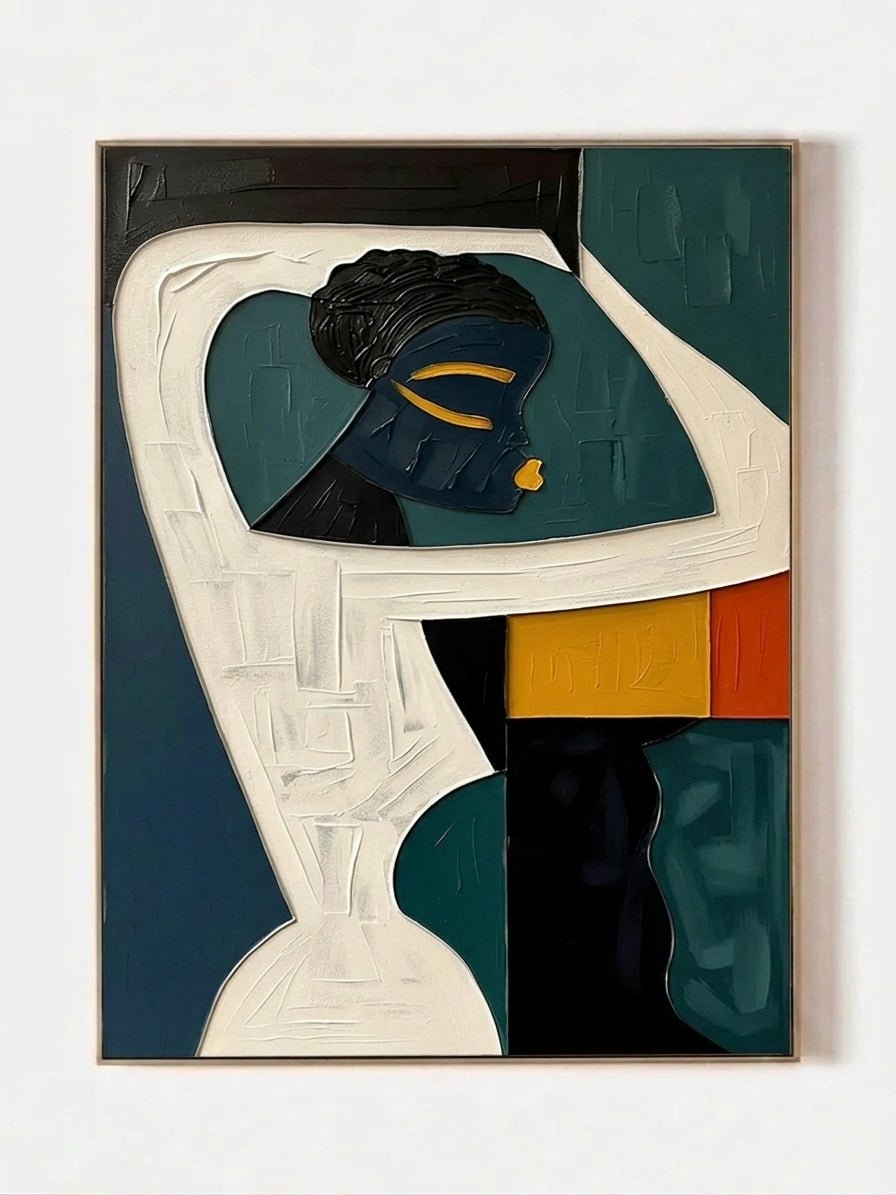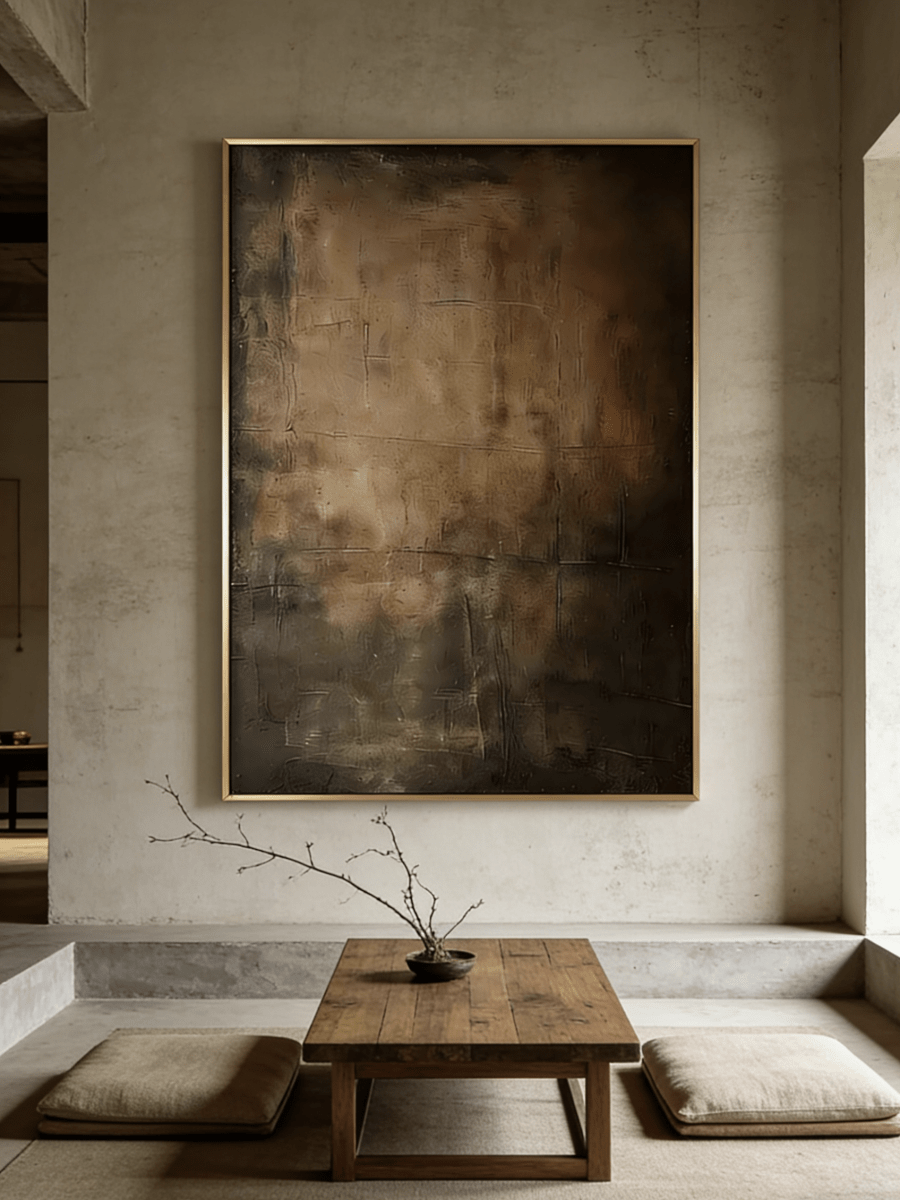

Choosing abstract wall art becomes easier when you stop asking what the painting represents and start watching where your eye travels. A low horizontal band can slow a room down. Stacked vertical forms can make a narrow wall feel more structured. Sweeping diagonals create momentum, while broad curves offer movement without sharp tension. The right choice depends on how you use the room, what lines already exist in the furniture, and how much visual activity you want to add. This guide uses four real hand-painted works from the WABI Wall Art Abstract collection to show how visual movement works in bedrooms, entryways, home offices, and living rooms.

What visual movement means in abstract art
Movement in a still painting is the path your attention follows through line, shape, contrast, repetition, and empty space. The Neuberger Museum of Art Education explains that artists can direct the eye by arranging these elements, and that diagonal or sweeping lines often feel more dynamic than straight horizontal and vertical ones. This is useful when shopping because two paintings with the same colors can give a room very different energy.
Visual movement is not a promise that a painting will make everyone feel the same way. Personal associations, lighting, scale, and surrounding objects all matter. Treat the categories below as a comparison tool. The goal is to notice what your eye does first, then decide whether that behavior supports the room.
A quick movement test before you choose
Open a full view of the artwork, step back from the screen, and give yourself five seconds. Then answer four questions:
- Where does your eye enter? Notice the darkest area, brightest mark, or strongest edge.
- Which direction does it travel? It may move sideways, upward, around a curve, or across a diagonal.
- Where does it pause? Large quiet fields, centered blocks, and repeated shapes can slow the path.
- Does the path repeat? A loop feels different from a single strong sweep that exits the frame.
Repeat the test from the room's main viewing position using a saved product image on your phone. A phone mockup is not color-accurate, but it can reveal whether the composition reinforces or fights the lines of the space.
Horizontal drift: quiet movement for rest

Horizontal movement usually gives the eye a clear, unhurried route. It is especially useful in a bedroom, reading corner, or meditation area where the art should hold attention without demanding constant scanning. The effect is strongest when the major value changes run from side to side and the upper part of the composition leaves generous breathing room.
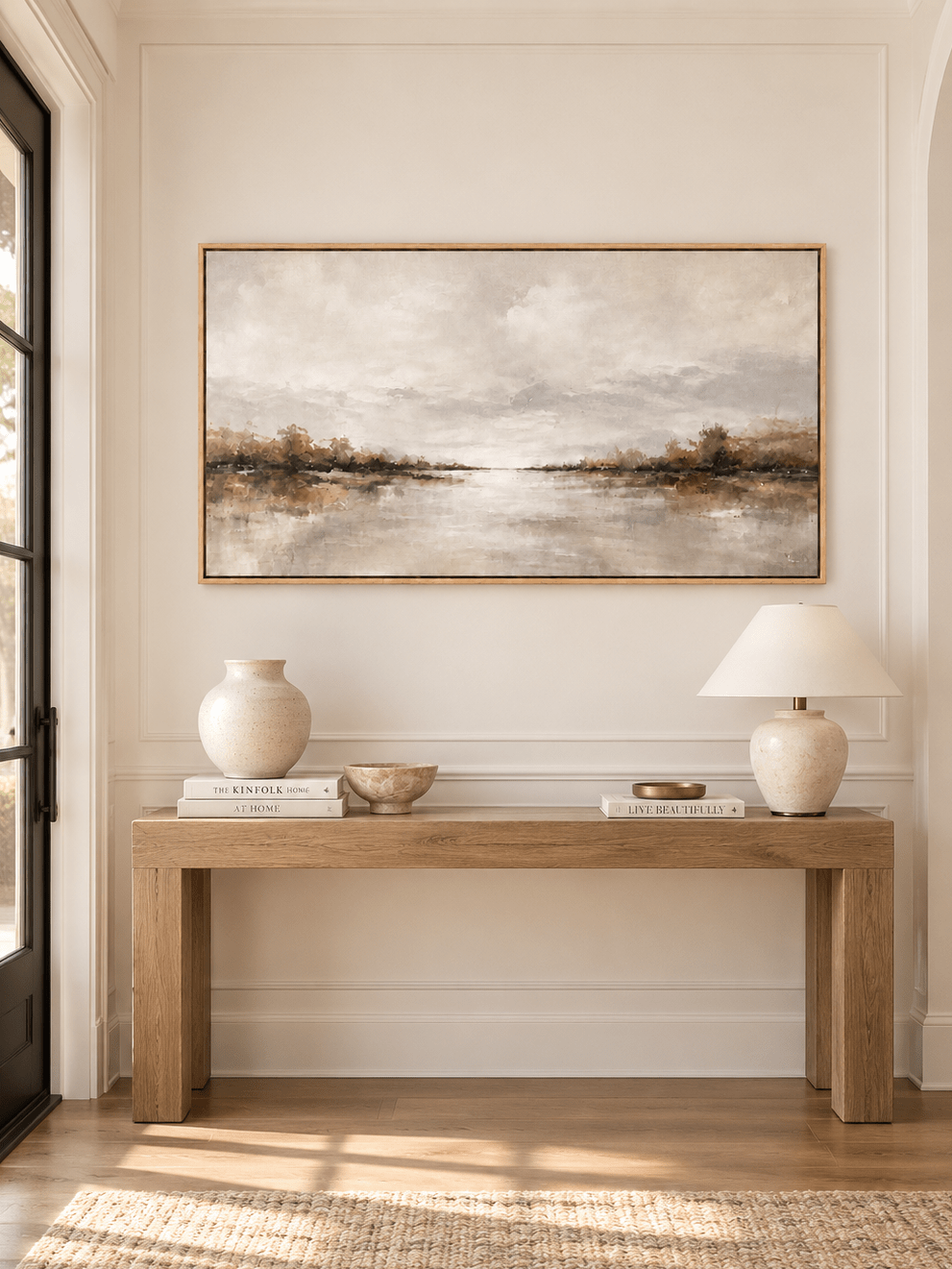
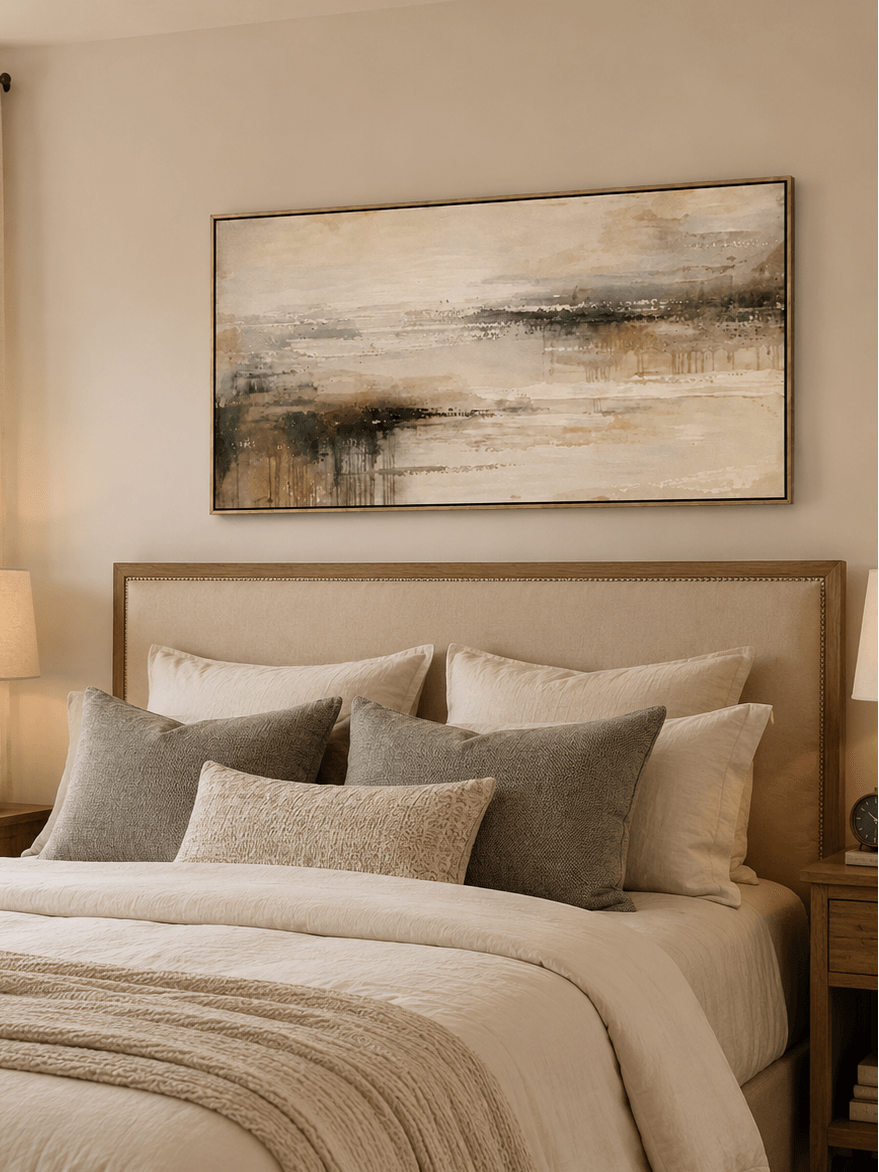
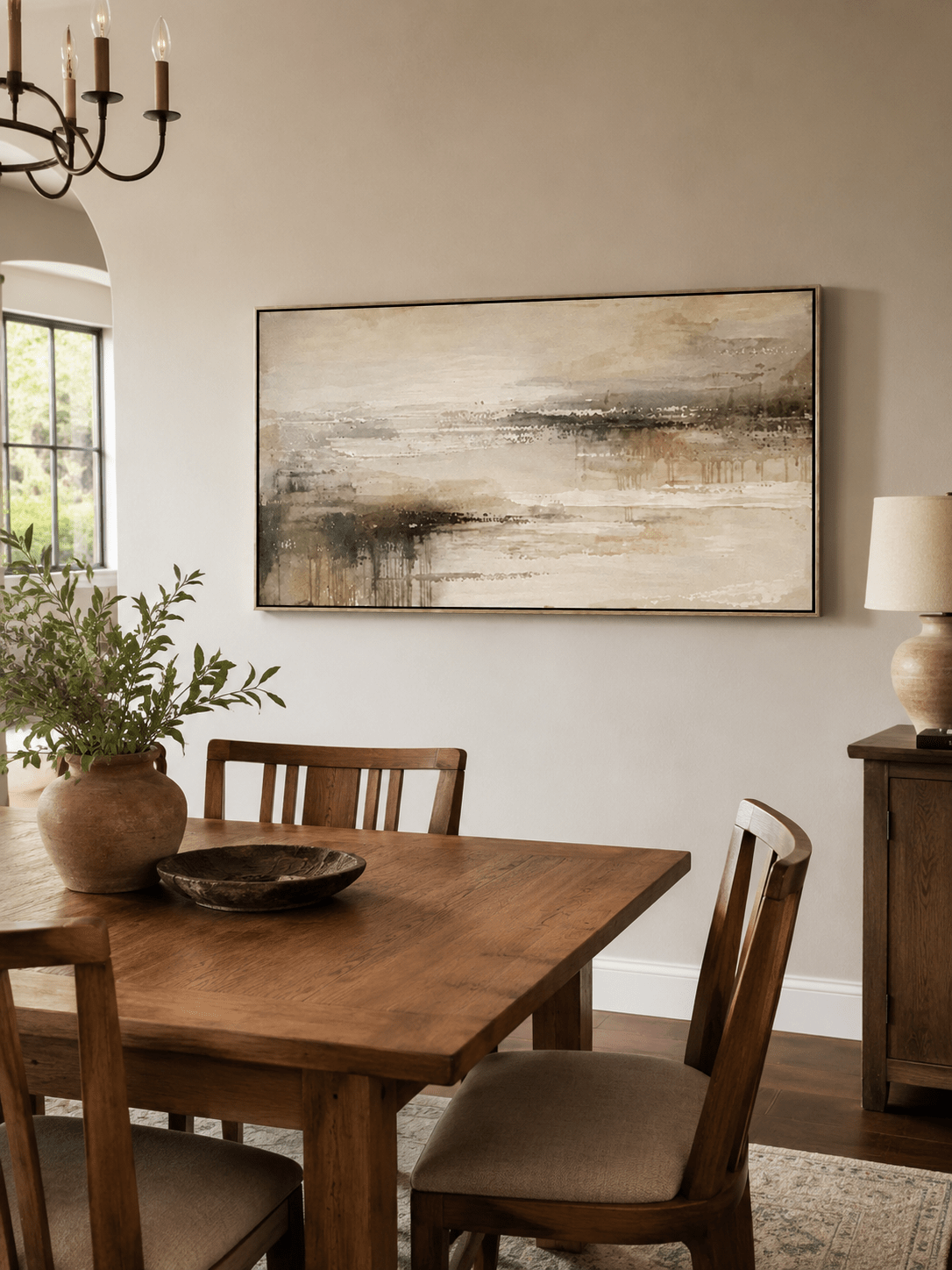
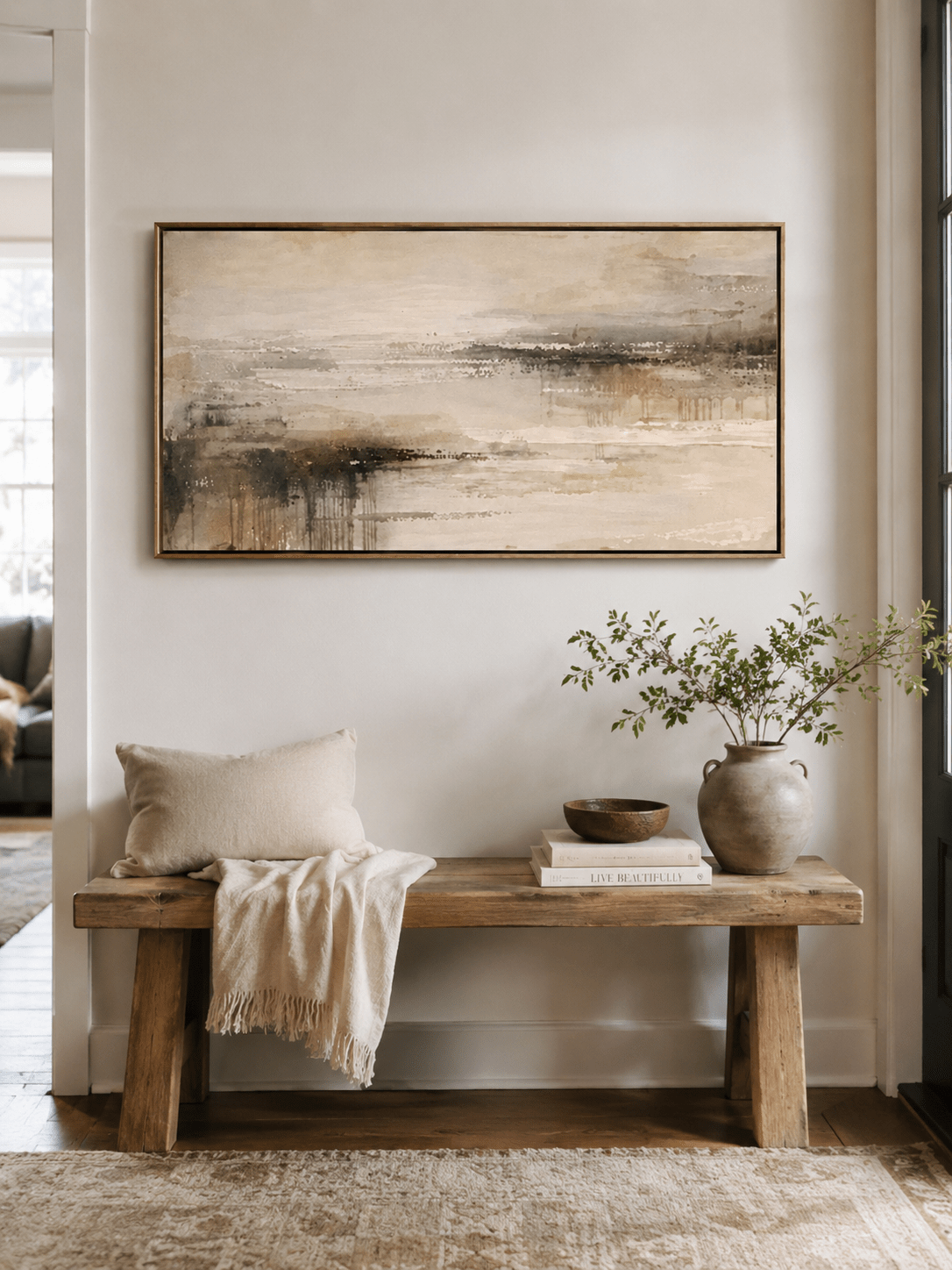
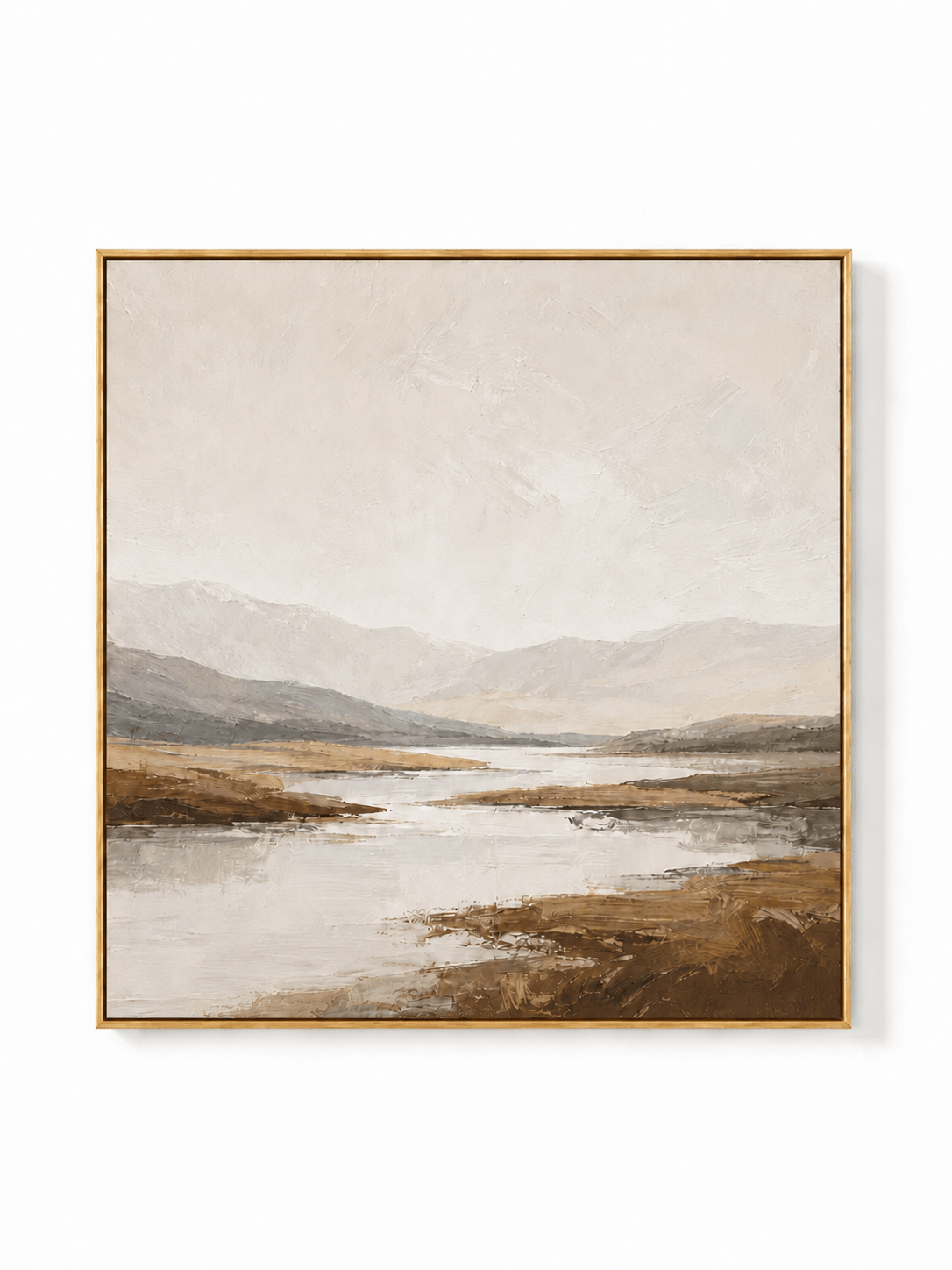
Minimalist Abstract Misty Lake Landscape Painting -EL#0152 by Evelyn Li is a square painting, but its internal movement is distinctly horizontal. A misty gray and beige field occupies most of the upper canvas. Espresso and taupe marks gather near the lower sides, while a pale lake-like band crosses the middle. Your eye drifts across that opening, pauses at the darker banks, and returns to the light center.
This work suits someone who wants abstract art with a trace of landscape rather than a completely nonobjective image. Its restrained contrast makes it quieter than the other examples. Above a bed, the internal horizon can echo the headboard without becoming another hard stripe. The product page offers square sizes from 24 by 24 to 72 by 72 inches, so test the outer dimensions with painter's tape before selecting a large version.
Stacked vertical rhythm: structure for transitional walls

Vertical movement can organize a narrow wall and lead the eye upward. When the forms are centered, straight-edged, and repeated, the result often feels stable rather than fast. This makes stacked geometry useful in entryways, between doors, beside a bookcase, or above a narrow console. It gives the wall a clear center of gravity while still acknowledging height.
Modern Geometric Abstract Canvas Wall Art -SR#0058 by Seraphina Rose builds a column from off-white architectural shapes. Olive areas sit at the lower corners, a darker green block caps the top, and stone-like texture softens the clean geometry. The composition reads upward, but the broad base and centered arrangement keep it grounded.
Choose this painting if your room already contains straight furniture lines and you want the art to reinforce them. It is more architectural than expressive. An oak console, rectangular runner, or simple cabinet can repeat the order, while a plant or rounded lamp prevents the scene from becoming too rigid. Because the piece is vertical, it also works where a square painting would leave too little wall around a doorway.
Diagonal sweep: deliberate energy for active spaces

Diagonal lines suggest a route that is still in progress. They pull attention from one zone to another and can make a static wall feel more active. This kind of movement is useful in a home office, creative studio, music room, or entry where you want an immediate focal point. It can be too restless for a room already filled with patterned textiles, open shelving, or many small objects.
Minimalist Abstract Canvas Wall Art -LP#0200 by Lena Petrova uses a deep black ground with layered charcoal areas and chalk-white outlines. Several lines sweep diagonally across the lower half, while taller looping marks rise at the sides. The high contrast makes every turn easy to follow. Among the four examples, this painting produces the strongest sense of momentum.
It works best when the surrounding wall has enough negative space. In a home office, a long credenza can provide a calm horizontal baseline below the energetic canvas. Walnut warms the black field, while a restrained rug keeps the composition from competing with another pattern. If the room is dim, use soft angled light that reveals the dark texture without creating glare. Our guide to lighting textured wall art explains why direction matters as much as brightness.
Curved flow: movement without sharp tension
Curves can carry the eye through several areas while avoiding the urgency of a diagonal slash. Broad, continuous curves tend to feel more fluid; short broken arcs can feel more playful. Curved movement is a practical middle ground for a living room or dining room that needs life but should still support long conversations and daily use.
Minimalist Abstract Earth Tone Wall Art -SR#0141 by Seraphina Rose combines large camel, cream, espresso, black, and pale blue shapes. Thick white bands loop between them, creating more than one possible route through the vertical canvas. The eye can follow the top arc, drop through the dark center, and return along the lower curve. Sand-like texture gives the broad shapes physical depth.
This is the most adaptable movement pattern in the group. It adds rhythm to a simple sofa wall but does not rely on a single aggressive focal point. Rounded tables or an arched doorway can echo the curves, while straight sofa arms keep the room balanced. Repeat only one or two colors, such as camel and pale blue, instead of matching every section of the painting.
Compare the four movement patterns
| Movement pattern | What guides the eye | Visual pace | Useful room | Example |
|---|---|---|---|---|
| Horizontal drift | Soft horizon and open central field | Slow | Bedroom or reading nook | EL#0152 |
| Stacked vertical rhythm | Centered blocks and repeated edges | Measured | Entryway or narrow wall | SR#0058 |
| Diagonal sweep | Crossing high-contrast lines | Fast | Home office or creative space | LP#0200 |
| Curved flow | Broad loops and interlocking shapes | Moderate | Living or dining room | SR#0141 |
Match the artwork to the room's existing lines
Start with the largest fixed shapes in the room. A long sofa, headboard, or low cabinet creates a horizontal baseline. Tall windows, bookcases, and doorways create vertical divisions. Arches, rounded tables, and curved sofas introduce arcs. You can either reinforce those lines or use the painting to provide a controlled contrast.
Reinforcement usually feels calmer. EL#0152 above a bed repeats the low horizontal emphasis even though the canvas itself is square. Contrast creates more tension: LP#0200 adds diagonal movement above a long, quiet credenza. Neither approach is automatically better. Decide whether the room needs continuity or a stronger interruption.
In an open-plan home, check the artwork from several sightlines. A dynamic piece that feels exciting from the desk may compete with another bold painting visible from the dining table. Our guide to coordinating wall art in open-plan rooms offers a practical anchor-and-support method.
Scale changes the speed of the composition
A larger canvas gives the eye more distance to travel. Broad curves may feel slower and more immersive at a large scale, while fine diagonal lines become easier to inspect. On a small canvas, the same composition can read as one compact graphic gesture. This is why judging only from a product thumbnail is unreliable.
Mark the proposed outside dimensions on the wall and view the outline from the doorway and primary seat. Then consider the internal composition. A tall vertical work needs enough clearance above and below to keep its upward movement visible. A square landscape needs enough width around it so the central horizon does not feel compressed. For measurement help, use the WABI Wall Art sizing guide.
Texture can strengthen or slow movement
Raised paint catches side light and adds small shadows to a line or shape. On SR#0058, the texture softens strict geometric edges. On LP#0200, tonal brushwork inside the black field creates quieter pauses between the bright lines. On SR#0141, the sand-like surface makes the broad curves feel substantial rather than flat.
Look at close-up product images when available and consider the room's lighting direction. Strong frontal glare can hide tonal variation, especially on a dark painting. Soft side light can reveal texture without overpowering the composition. Since hand-painted surfaces can vary subtly, expect the exact ridges and marks to have an individual character while the main palette and composition remain recognizable.
Common mistakes when judging movement
- Choosing by color alone: Similar neutral palettes can feel calm, rigid, fluid, or energetic depending on the composition.
- Ignoring the room's pattern load: Fast diagonal art may compete with a patterned rug, open shelves, and busy upholstery.
- Confusing vertical format with vertical movement: A tall canvas may still contain circular or horizontal paths.
- Using several dominant pieces in one sightline: Let one artwork lead and choose quieter support pieces nearby.
- Forgetting viewing distance: Fine lines need enough contrast and scale to remain legible from the main seat.
- Letting furniture crop the visual path: Leave enough wall space so the outer curves, lines, and negative areas can breathe.
Frequently asked questions
What kind of abstract art feels calm?
Look for open negative space, soft value transitions, low horizontal movement, or a centered composition with few sharp contrasts. Test your response rather than relying on color names alone.
Is dynamic abstract art suitable for a bedroom?
It can be, especially if you enjoy strong visual energy. If your goal is rest, a slower composition with fewer crossing diagonals may be easier to live with near the bed.
Do vertical lines make artwork better for a narrow wall?
Vertical format usually fits a narrow wall more naturally, but internal movement also matters. Centered stacked forms can emphasize height without feeling unstable.
How do I balance a black abstract painting?
Give it open wall space and a simple furniture baseline. Warm wood, cream textiles, and controlled lighting can keep a dark canvas from making the entire room feel heavy.
Should the curves in the art match curved furniture?
No exact match is required. Repeating one rounded element can create continuity, while straight furniture can provide a useful counterbalance.
Can two abstract paintings with different movement share a room?
Yes. Choose one as the visual anchor and let the other be quieter in scale, contrast, or texture. Check whether both are visible in the same sightline before ordering.
Choose the path you want the eye to follow
The most useful question is not simply, "Does this abstract painting match my room?" Ask what path it creates and whether that pace belongs in the space. Horizontal drift supports rest, stacked geometry adds order, diagonals bring momentum, and curves offer fluid connection. Once you identify the room's existing lines and desired energy, compare the four examples or explore the full Abstract Wall Art collection. Choose a composition you enjoy following, then confirm its scale, texture, and lighting before you order.